“
Introduction: Hidden Within Each Breath, a Century-Old Unsolved Mystery?
We breathe every day, so accustomed to it that we don’t even think about what is actually in the air. But did you know? There is a puzzle in the scientific community regarding airborne particles that has left brilliant scientists completely stumped for an entire century. Just recently, a research team from the University of Warwick in the UK finally broke the deadlock and cracked this tough nut of a problem. Today, this article will take you through how this breakthrough provides a powerful boost to our fight against air pollution.
Why Were Scientists Stumped by This for a Hundred Years?
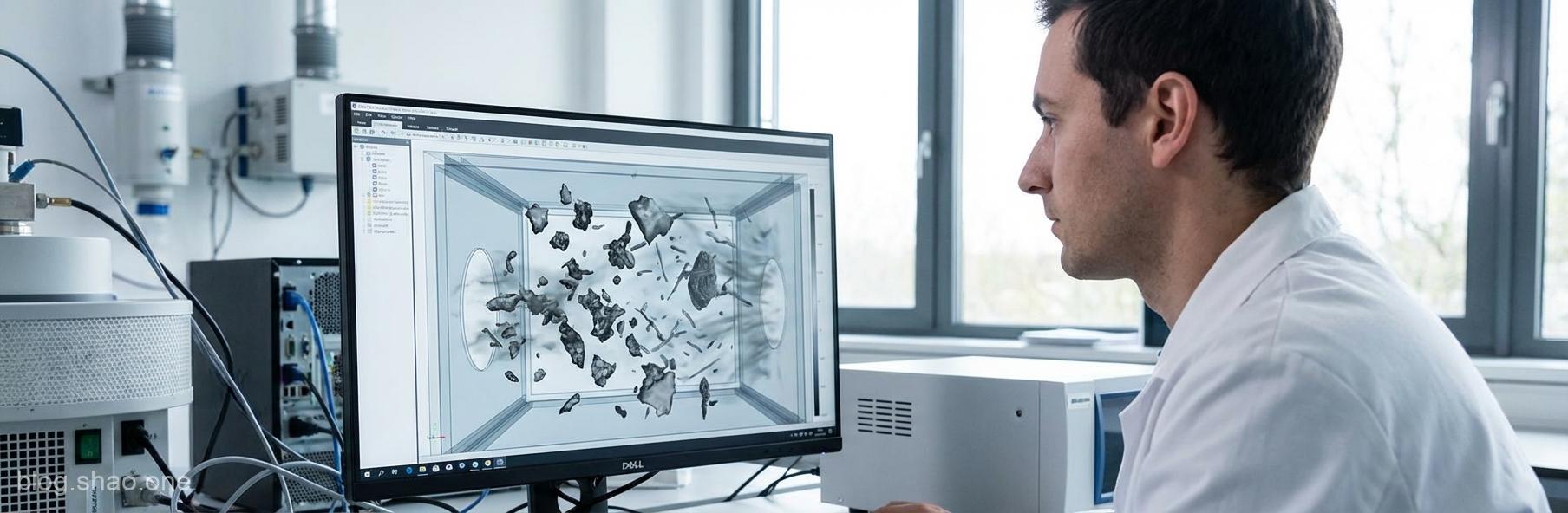
When we talk about tiny particles in the air, we intuitively think of PM2.5 or dust. In the world of physics, predicting how these particles move is usually based on the assumption of a sphere. Simply put, scientists used to calculate particles as if they were perfectly round little balls. But reality is often harsh: real pollutants—such as soot in exhaust, microplastics, or viruses—are actually misshapen and completely irregular.
- Past Bottleneck: When particles are not spherical, the drag and collisions they experience in the air become extremely complex. It is like throwing a baseball (which is round), where it is easy to predict where it will land, but if you throw an irregularly shaped stone, the way it darts around in the air will leave you completely confused.
- Computational Disaster: Over the past century, the amount of calculation required to predict the motion paths of these non-spherical particles was so massive that researchers constantly hit a wall.
The University of Warwick’s Advanced Tech: Making Irregular Particles Nowhere to Hide
The University of Warwick research team has demonstrated the value of experience and expertise by developing a brand-new mathematical modeling method. This method can accurately predict how these oddly shaped nanoparticles randomly float in the air (known as Brownian motion).The secret to this technology lies in the fact that they no longer try to use simplified models. Instead, they use highly sophisticated new algorithms to simulate the interaction between different-shaped particles and air molecules. This is not just a theoretical victory, but a giant leap in practice.
Key Points of This Breakthrough:
- All-around Modeling: Whether it is elongated fiber-like plastics or branched soot like snowflakes, they can now be accurately simulated.
- Significant Accuracy Boost: In the past, the range of error might have caused scientific data to fall into chaos, but the new method provides extremely high prediction accuracy.
- Cross-disciplinary Application: This research is not only applicable to environmental science but also holds great reference value for pharmaceutical engineering (such as inhalers).
Why Is This Closely Related to Our Daily Lives?
You might ask: What does this have to do with my life? Actually, it has a lot to do with it! The significance of this discovery lies in its ability to directly improve our health and environmental monitoring. Here are several of its major impacts:
- More Precise Air Pollution Warnings: Now when we check air quality apps, the data is mostly based on total volume. With this technology, environmental agencies can more accurately predict how pollutants of specific shapes (such as soot emitted by specific factories) will diffuse, rather than just guessing based on incomplete information.
- A Glimmer of Hope for the Microplastic Problem: Microplastic pollution has intensified in recent years, and since these particles are extremely irregular in shape, they are very difficult to track. Now, scientists finally have the tools to study how these microplastics enter our lungs and water sources through atmospheric circulation.
- A New Tool for Epidemic Prevention: The transmission patterns of viruses and aerosols are closely related to their shapes. Understanding the movement trajectories of irregular particles can help us design more effective filtration systems or social distancing guidelines; it can truly be described as a life-saving discovery.
Tech Review: After Solving the Mystery, the Challenge Is Just Beginning
The success of this research is not only about solving a century-old physics mystery but also a major contribution to human health management. In Taiwan, we have always been very concerned about PM2.5 issues. If this technology can be installed in future sensors, it will allow our protective measures to become precision strikes.From a scientific perspective, this also proves that even seemingly insignificant dust movement, if studied diligently, can lead to a brand-new horizon. Although this technology is currently in the academic and high-end application stage, I believe that in the near future, this stroke of genius algorithm will be integrated into our daily lives. Let us wait and see what other surprises this group of scientists can bring us!
This report is based on news from ScienceDaily regarding the University of Warwick solving a century-old airborne particle puzzle.“