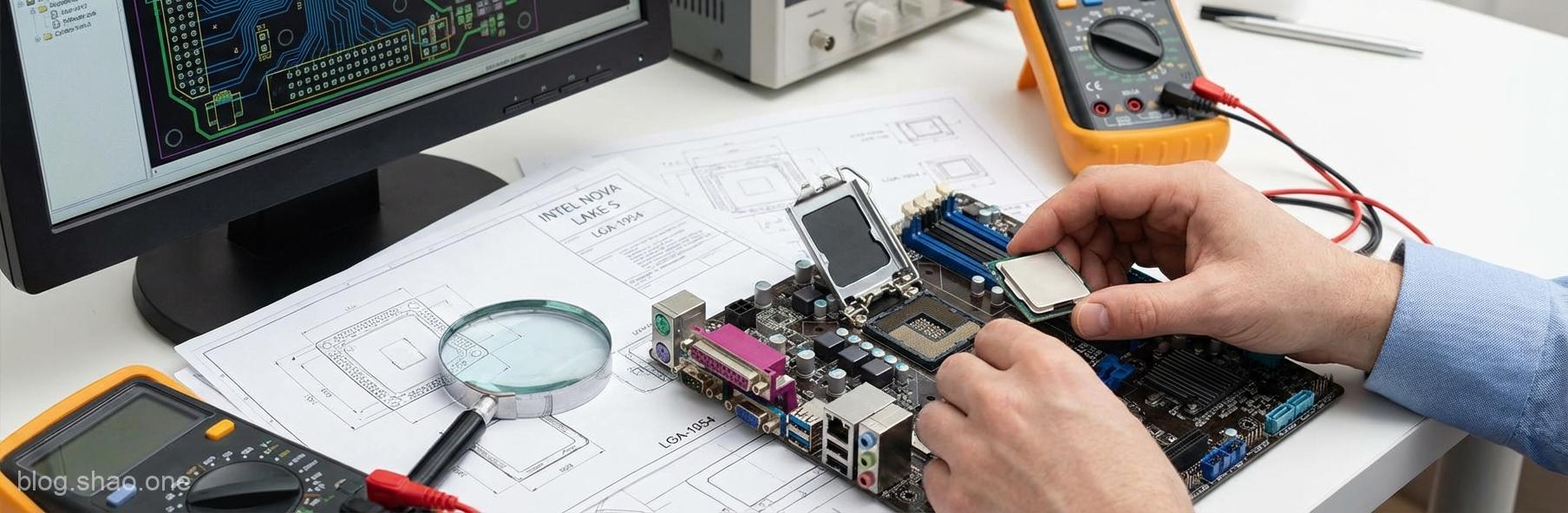
“Dear 3C enthusiasts and PC DIYers, please take a deep breath and sit tight! While everyone is still eagerly awaiting Intel’s 15th Gen Arrow Lake (Core Ultra 200 series) to show its strength, the well-known tech media VideoCardz has dropped a bombshell. According to the latest leaked roadmap information, Intel is already paving the way for the more distant future—Nova Lake-S desktop processors. The accompanying Z990 and Z970 chipsets, along with the brand-new LGA-1954 socket, are truly staggering.Is this news a sign of Intel’s ‘proactive planning,’ or just another ‘heart-stopping’ upgrade cycle for players? Today, we will deep-dive into this leaked information to see what Intel really has in store.
I. The Blue Giant’s Long-Term Strategy: Z990 and Z970 Emerge
According to the leaked roadmap, Intel has clearly set its sights on 2025 and even 2026 and beyond. Although everyone’s current focus is on the upcoming Z890 chipset using the LGA-1851 socket, Intel has quietly added Z990 and Z970 to its development list. For the hardware community, this is a classic case of ‘planning the roof before the foundation is even dry.’
- Core Status of Nova Lake-S: This generation of processors is seen as Intel’s future heavy-hitter, expected to bring significant performance improvements and power efficiency optimizations.
- Chipset Tiers: Following tradition, Z990 will target top-tier overclockers, while Z970 will be the ‘best value choice’ for the mid-to-high-end PC building market.
II. LGA-1954 Socket: Another Case of ‘Upgrade Fever’?
The news that has caused the most ‘boiling’ discussion among netizens is the appearance of the new LGA-1954 socket. If you thought LGA-1700 (12th to 14th Gen) lasting three years was a show of good faith, then this news might make you feel that ‘plans can’t keep up with changes.’
- Socket Musical Chairs: The upcoming Arrow Lake is just about to start using LGA-1851, yet Nova Lake is already set to jump to LGA-1954. This means LGA-1851 might become a relatively short-lived platform, causing many players who planned for long-term upgrades to feel ‘heavy bleeding in their wallets.’
- Increased Pin Count: Increasing to 1954 pins means more power delivery channels or data transmission I/O between the processor and the motherboard. This usually hints at support for more powerful AI computing units or higher-frequency DDR5/DDR6 memory.
Regarding this frequent socket-changing move, complaints about ‘milking the fans’ are inevitable in the community. After all, changing a socket means having to swap out the motherboard as well, which is indeed a ‘heavy burden’ for many veteran players.
III. The Significance of Nova Lake: It’s More Than Just ‘Squeezing Toothpaste’
Although detailed specifications are not yet fully revealed, Nova Lake’s positioning is no small matter. If Arrow Lake is Intel’s ‘litmus test’ during its process transition period, then Nova Lake is highly likely to be the ‘killer blow’ for Intel to truly return to the pinnacle.
- Performance Outlook: Rumors suggest Nova Lake will feature a significant architectural overhaul, particularly in multi-core coordination and cache design, aiming to leave its competitor AMD far behind.
- The Complete AI PC: With the AI wave hitting hard, Nova Lake will inevitably strengthen the computing power of the NPU, ensuring your desktop isn’t just for gaming, but can also become a true personal AI workstation.
IV. Perspective and Commentary: What Should Players Do?
Faced with Intel’s ‘constantly changing’ or ‘calculated’ strategy, how should we as consumers view this?
- Don’t Rush to be an ‘Early Adopter’: If you are currently planning to build a new machine, Arrow Lake with LGA-1851 is still the immediate choice. Although Nova Lake sounds enticing, ‘distant water cannot quench a nearby fire,’ and by the time Nova Lake actually hits the market, it will likely be two years from now.
- Challenges for Motherboard Manufacturers: Frequent socket changes aren’t just hard on players; they are also tough for motherboard manufacturers. How to maintain product differentiation amidst high-frequency generation changes will be a ‘head-scratching’ puzzle for vendors.
- Pressure from Competitors: With Intel making frequent moves, everyone is also watching to see how AMD will respond. If AMD’s AM5 platform can truly fulfill its ‘longevity promise,’ then Intel’s frequent upgrade strategy might lose a portion of core players who value long-term utility.
V. Conclusion: Wait and See, Protect Your Wallet
In summary, the exposure of Intel Z990/Z970 and LGA-1954 showcases the ‘ambitious’ future blueprint of this semiconductor giant. While details are still like ‘viewing flowers through a fog,’ it is certain that competition in the future desktop processor market will only get more intense.For the majority of players, the best strategy right now is to ‘wait and see.’ In tech, ‘early buyers enjoy early, late buyers get a discount.’ Before the next generation of products is officially released, see if your current computer can still hold up. There’s no need to feel anxious over a blueprint set for two years from now. After all, in the tech world, ‘sincerity’ is often harder to come by than ‘specs’!What are your thoughts on Intel’s practice of frequently changing sockets? Are you looking forward to breakthroughs in new technology, or do you feel this is making things difficult for players? Welcome to share your honest thoughts with us in the community!“