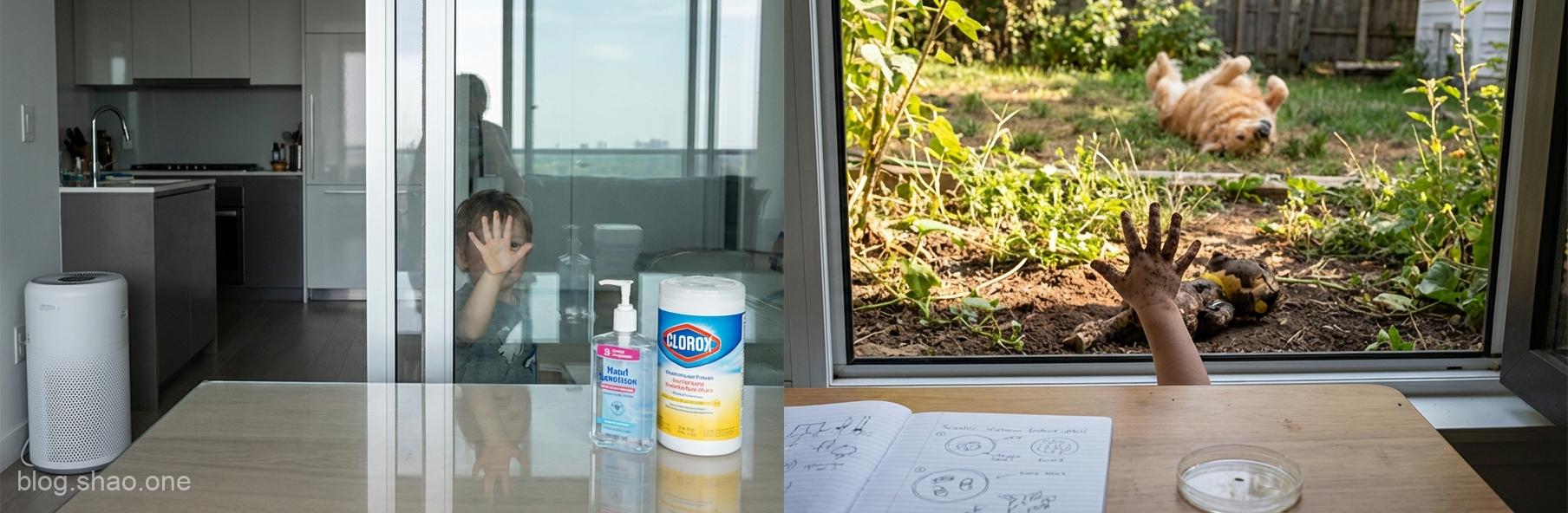
“Hello to all readers interested in technology and biomedical trends! In today’s post-pandemic era, where everyone carries a bottle of alcohol and every household pursues a spotless environment, our obsession with cleanliness seems to have reached the point of being excessive. However, a study recently published in the top scientific journal Nature has given us a loud wake-up call: being too clean might be the very culprit behind your allergies!Today, we will conduct an in-depth analysis of this heavyweight research on Environmental Induced Immune Imprinting, looking at how scientists used mouse experiments to uncover the mysterious veil behind allergy symptoms.
🔬 Greenhouse Flowers in the Lab vs. The University of Life in the Outside World
The starting point of this research is very interesting. Scientists observed that lab mice raised in a germ-free environment, though living in luxury and comfort, had immune systems as fragile as paper. In contrast, those wild kids—mice bought from pet stores and exposed to various environmental microorganisms—showed extremely strong resistance.The research team used multiple strains of mice (including 129S1/SvImJ, A/J, BALB/cJ, etc.) for comparative experiments. They found:- Environmental stimulation is key: Early exposure to environments full of microorganisms can induce adaptive immune memory in mice with cross-reactivity.- The grindstone of the immune system: These environmental antigens act like drill sergeants for the immune system, training immune cells to learn what is a real threat and what is just harmless dust.
🧠 Core Mechanism: What is Immune Imprinting?
The greatest contribution of this study is the proposal of the mechanistic theory of Immune Imprinting. Simply put, when we are exposed to bacteria or antigens in the environment during childhood, the immune system leaves a deep first impression.
- Cross-reactivity: Certain harmless molecules in the environment are structurally similar to common allergens. When the immune system learns to handle these environmental molecules, it can remain calm when encountering similar allergens in the future, without launching a destructive immune attack.
- Suppression of Type II immune responses: Allergies are usually caused by excessive Type II immune responses. Research shows that early environmental training can effectively suppress this response, preventing the immune system from overreacting.
This confirms the scientific basis for the saying that being a bit dirty keeps you healthy to some extent. If the immune system lacks training during its early development, it will lose its sense of proportion as it grows up, launching all-out attacks on minor things like pollen and dust mites—this is the origin of allergies.
💡 Tech Analysis and Expert Commentary: How does this affect us?
As a technology news observer, the significance of this research is absolutely pivotal. It is not just a new discovery in biology; it provides a blueprint for future preventive medicine:
- The rise of precision prevention: In the future, we may not need to hide from allergens but instead perform immune training during infancy through biomimetic environmental vaccines to achieve the effect of nipping problems in the bud.
- The ultimate proof of the Hygiene Hypothesis: For decades, the Hygiene Hypothesis remained at the statistical level. Now, the Nature study provides mechanistic evidence at the microscopic level, giving this theory official legitimacy.
- A new blue ocean for the biotech industry: Since being too clean is the problem, developing safe and controlled environmental microbial probiotics to simulate natural exposure will be the next gold mine for the biotech industry.
📝 Conclusion: Returning to the Middle Way of Nature
This study is not telling everyone to stop washing their hands from now on, but rather reminding us that while pursuing the convenience and cleanliness brought by modern technology, we should not completely sever ourselves from the natural environment. Excessive protection will instead cause our immune system to give up halfway, losing its proper defensive functions.In today’s rapidly developing technological world, sometimes the most advanced medical solution is actually to go back and learn how nature works. Instead of locking children in a germ-free room, it’s better to occasionally let them go to the park to get some fresh air and touch the ground—this might be the best upgrade patch for their immune system.Has this research changed your view on dirt? Welcome to leave a comment below to share your perspective! See you next time!”