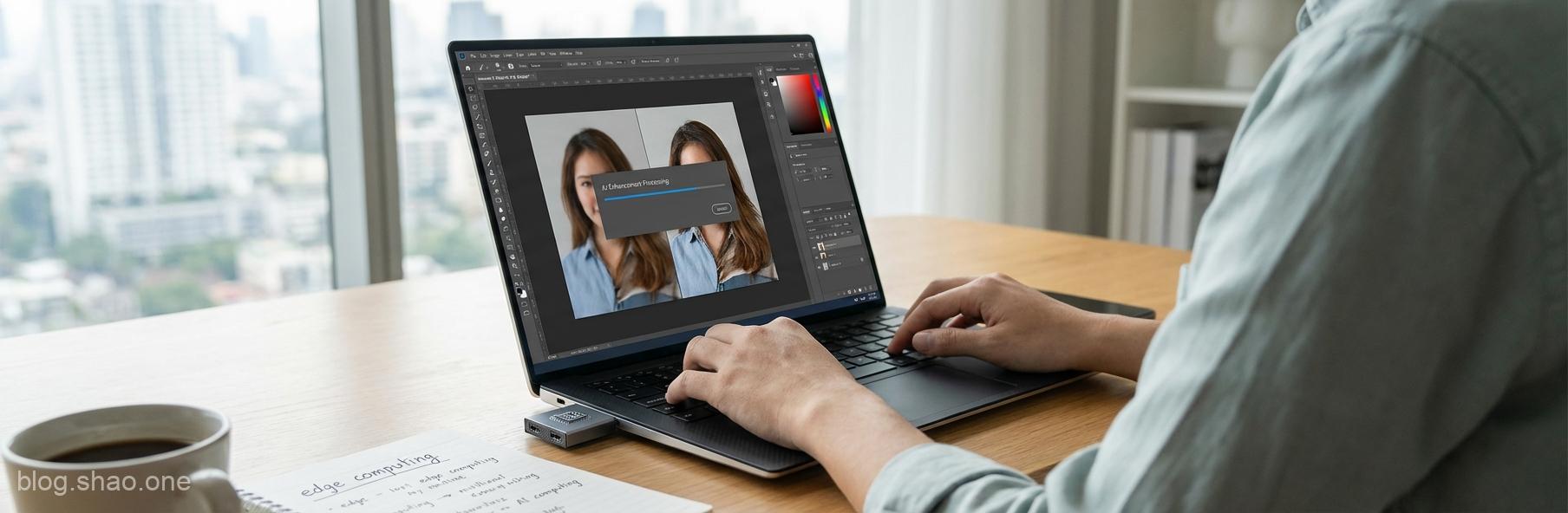
“Hello everyone, and welcome to today’s in-depth tech analysis. The hottest topic in the tech world recently is how Artificial Intelligence (AI) is moving from distant cloud data centers into the personal computers (PCs) we use every day. According to the latest report from the Financial Times, the PC industry is standing at a major turning point. Today, we’re going to talk about this ongoing ‘edge computing’ revolution.
⚡ Cloud is No Longer the Only Way: AI Computing Power is Moving to the ‘Edge’
Over the past year, when we talked about AI, we usually thought of services like ChatGPT or Midjourney that rely on massive cloud servers. But the Financial Times points out that processing technology is beginning to migrate from data centers to the so-called ‘Edge’—that is, your laptop or desktop.What does this mean? Simply put, future computers will no longer just be tools for displaying web pages or editing documents, but a local brain with ‘thinking capabilities.’ This transformation is being called the rise of the ‘AI PC’ by the industry, and it is expected to drive the largest wave of hardware iteration since the dawn of the internet era.
🔍 Why go ‘Down to Earth’? Three Key Advantages of AI PCs
Many people might ask: ‘Isn’t cloud computing great? Why insist on stuffing AI into a computer?’ This is about being ‘down to earth’—letting the computing happen as close to the user as possible. There are three main key reasons:
- Privacy and Security: This is the ‘must-contested territory’ that corporate users care about most. If AI processing can be completed locally, sensitive data does not need to be uploaded to the cloud, greatly reducing the risk of security leaks.
- Low Latency and Smoothness: Processing commands locally can achieve instant results. Whether it’s real-time translation or audio-video editing, it is no longer limited by the fluctuating speed of the internet.
- Cost & Efficiency: For software vendors, cloud computing power is as expensive as gold; for users, local processing can save on subscription fees. This is the ‘wool comes from the sheep’ logic—bringing computing power back to the local device saves resources for everyone in the long run.
⚔️ Hardware Giants’ ‘Arms Race’: A Battlefield of a Hundred Schools of Thought
To welcome this revolution, chip giants have long been gearing up. Intel, AMD, and the aggressively entering Qualcomm have all integrated NPUs (Neural Processing Units) specifically for handling AI tasks into their chips. This is no longer just a simple performance boost, but a total overhaul of hardware architecture.We can see that the current PC market is no longer making minor ‘old wine in new bottles’ changes, but a true ‘rebirth.’ This competition is not just about stacking specifications, but about who can be the first to define ‘killer applications’ that make consumers feel the upgrade is truly significant.
🎙️ In-Depth Commentary: Is the AI PC a True Revolution or a Marketing Gimmick?
As a tech observer, I believe the emergence of the AI PC is definitely like ‘adding wings to a tiger,’ but it is currently at the stage where ‘everything is ready except for the east wind.’ While the hardware is ready, whether current software applications can make the general public feel it’s a ‘must-buy’ remains to be seen.The major significance of this is: It breaks the long-standing stagnation of the Wintel (Windows + Intel) architecture. Now, the challenges of the Arm architecture and AI demand are intertwined, reigniting the long-lost fire in the PC market. This is definitely a good thing for consumers, as competition will bring better products and more competitive prices.
💡 Conclusion: What Should We Expect?
In summary, an AI PC is not just a ‘computer with added AI functions’; it is a key turning point for the PC industry to ‘revitalize its business.’ As computing returns from the cloud to personal devices, the way we interact with the digital world will be redefined. Although the market is currently flooded with a dizzying array of products, I suggest everyone wait for reviews of the first wave of products to see which features can truly improve your work efficiency.Do you have any expectations for AI PCs? Do you think this will be the next tech craze, or just a tactic for manufacturers to boost sales? Feel free to share your thoughts in the comments section!
This content was compiled by our tech correspondent based on reports from the Financial Times with additional in-depth analytical perspectives.“