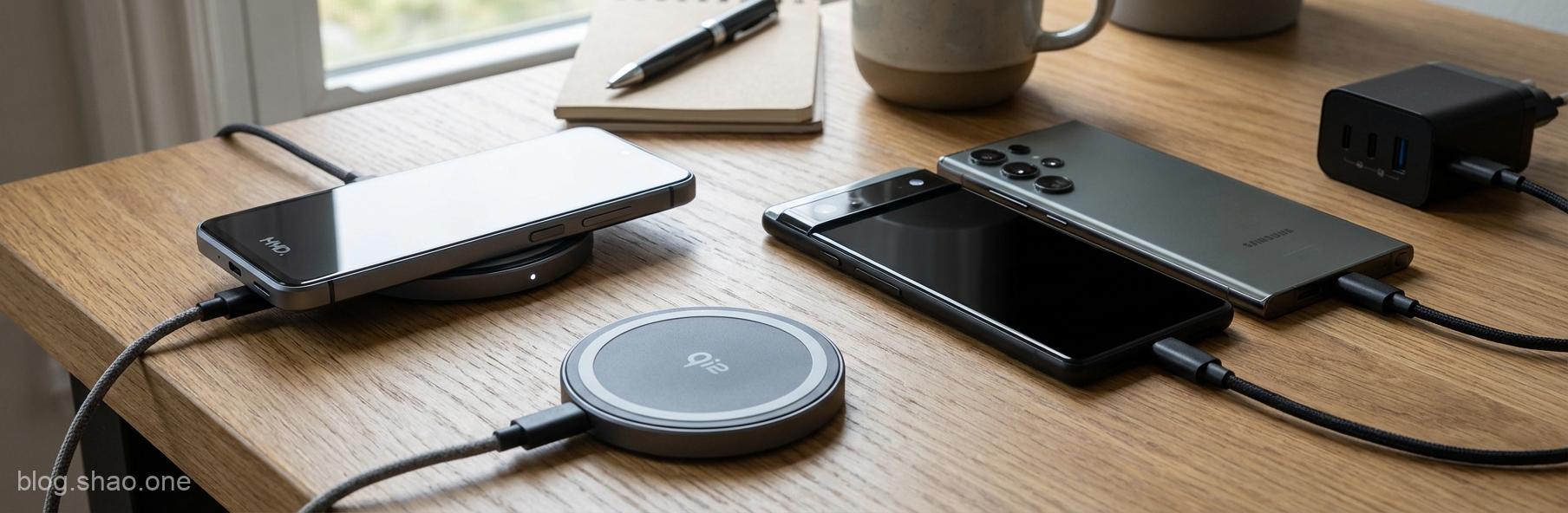
“Hello, dear tech fans! Welcome back to this week’s tech deep dive. Today’s topic is something that, for those who have long followed smartphone hardware development, is definitely a ‘bittersweet’ subject—the progress of the Qi2 wireless charging standard’s adoption in the Android camp.
💡 Magnetic Charging: Long-awaited by Android Users
Since Apple launched MagSafe, iPhone users have enjoyed the convenience of ‘snap-and-go’ precise charging and accessory mounting. In contrast, while the Android camp’s wireless charging technology isn’t lagging behind, it seems to be ‘late to the party’ when it comes to unifying magnetic standards.Finally, we saw a turning point in 2024. The Qi2 standard officially incorporated Apple’s magnetic alignment technology into its specifications. In theory, it should have started appearing on major flagships like ‘mushrooms after rain.’ However, reality is quite harsh. According to the latest reports from 9to5Google, there are currently very few phones on the Android market that truly support Qi2. Aside from Google’s plans to heavily promote it with the Pixel 10 series, other major manufacturers seem to be ‘staying put.’
📱 HMD Unexpectedly Leads; Samsung to Wait Until 2026?
The most shocking news recently is that HMD (HMD Global) is about to launch a new phone that supports Qi2. For those users who have been waiting anxiously for magnetic features, this is undoubtedly ‘a welcome relief.’ Although HMD’s market share is not what it was during Nokia’s peak, this ‘courage to be first’ has certainly taught the big players a lesson.However, the most disappointing news for the vast number of Samsung fans is Samsung’s recent direction. According to industry rumors, Samsung might not fully introduce Qi2 to its flagship models until 2026. This makes one wonder, in such a highly competitive tech world, is Samsung’s ‘steady and cautious’ strategy a case of ‘fine work taking time’ to ensure quality, or is it a ‘sluggish move’ reflecting a slow reaction?Here is a summary of the current Qi2 support status in the Android camp:
- Google Pixel 10 Series: Currently seen as the ‘bellwether’ for promoting Qi2 in the Android camp, it is expected to bring the most complete magnetic ecosystem experience.
- HMD New Phone: An unexpected pioneer, proving that Qi2 isn’t just for flagships; the mid-range market can also ‘expect it soon.’
- Samsung Galaxy Series: Rumors suggest the S25 might miss out, and magnetic features won’t appear until 2026 at the earliest, leaving many users who look forward to ‘snap-to-charge’ convenience ‘looking on in disappointment.’
- Other Chinese Brands: Most are currently taking a wait-and-see approach or prefer developing their own proprietary fast charging protocols, causing the adoption of universal standards to move at a ‘snail’s pace.’
🔍 In-depth Commentary: Why is everyone ‘waiting’?
Why is it that a technology that can clearly significantly improve user experience is finding it so difficult to gain traction in the Android camp? I believe there are several key reasons:
- Structural Design Challenges: The addition of magnets affects the internal spatial layout of the phone and may even cause electromagnetic interference with Samsung’s pride and joy, the S-Pen. For manufacturers pursuing extreme thinness or specific features, this is a test of ‘having one’s cake and eating it too.’
- Ecosystem Inertia: Many Android manufacturers have already invested huge R&D budgets into their own proprietary wireless fast charging (such as 50W, 80W, or even higher). While switching to Qi2 brings compatibility, its charging power might not be as ‘spectacular’ as their own in-house technology.
- Cost Considerations: In today’s saturated smartphone market, every penny of cost must be spent wisely. Manufacturers may be calculating whether magnetic functionality can truly be the ‘final nudge’ that convinces consumers to switch phones.
📢 Summary: Inevitable, But Patience Required
Although the road to adoption is full of bumps, I believe that the spread of Qi2 is absolutely ‘the general trend.’ When third-party accessory makers start mass-producing Qi2 power banks, car mounts, and wallet accessories, flagship phones lacking magnetic functionality will seem out of step with the times.For us consumers, now might be a good time to ‘wait and see.’ If you absolutely must have magnetic features in the near future, the Pixel 10 might be your best bet; if you are a die-hard Samsung fan, you might have to practice your patience. After all, ‘the best is saved for last.’ Hopefully, in 2026, Samsung can give us a ‘show-stopping’ solution.The magnetic war in the Android camp has just begun. Who will have the last laugh? We shall wait and see!
Enjoyed this tech analysis? Don’t forget to share it with your tech-enthusiast friends and leave a comment below. Do you think magnetic features are a ‘must-have’ for you or a ‘gimmick’?“