“
Opening Statement: This is not merely medical news—it is a biological-level "system collapse."
Tech geeks and data nerds, happy new year! While we're buried in AI computing power, glued to CES news, or agonizing over the latest GPU performance, the real-world "biological virus" clearly isn't taking a holiday. Just recently, Kentucky delivered some truly terrifying news:The popular tourist attraction "Ark Encounter" has revealed a measles exposure risk. This incident isn't just a public health issue; from a tech curator's perspective, it resembles a major chain infection crisis triggered by a "human firewall failure." Today, we'll dissect this event to see what happens when the real world's antivirus software expires.
Incident Recap: The Visitor Who "Did Not Install Updates"
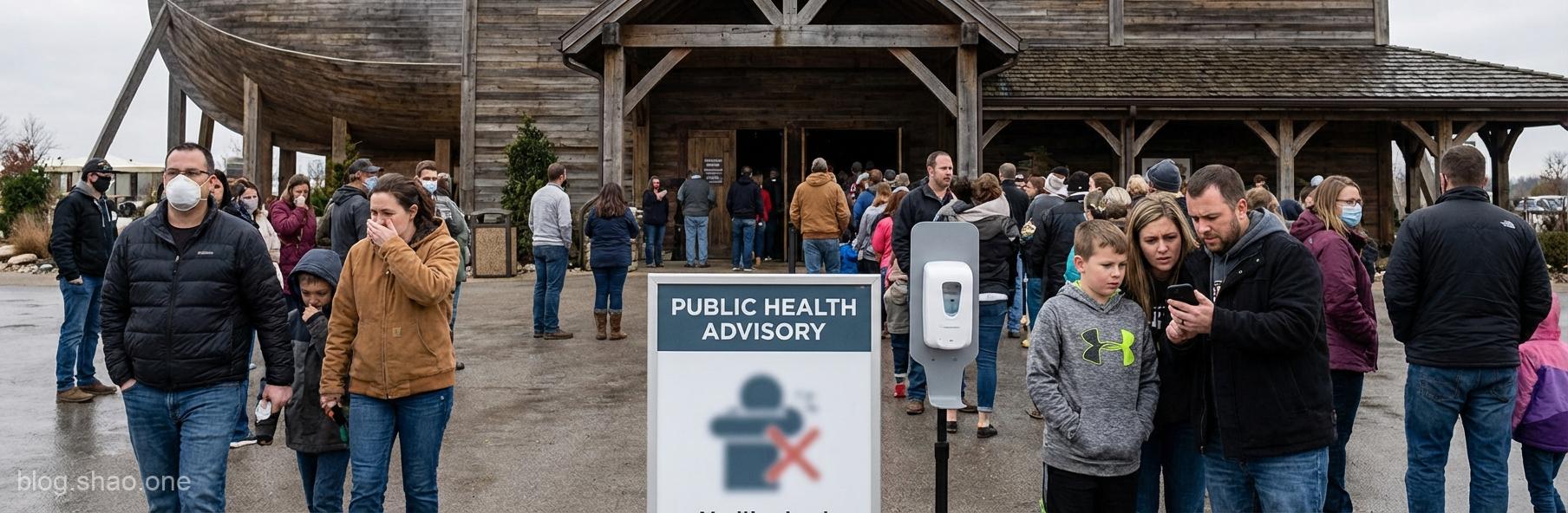
According to the latest report from WDRB, the Kentucky Department of Health has issued an emergency warning to the public. The trigger for this incident was an "unvaccinated" out-of-state traveler. Below are the key points of the incident, which can be viewed as a "path tracing" of the virus's spread:
- Source of infection: An unvaccinated measles traveler who crossed state lines.
- Exposure date: December 29 last year. This coincided with the peak travel season at year-end, when crowds were overwhelmingly large.
- Core Location: Ark Encounter, the renowned theme park in Williamstown.
- Subsequent movements: The traveler stayed at a nearby hotel for several days, indicating that exposure risks extend beyond a single attraction and have spread throughout the entire tourist community.
Health officials in Kentucky are now facing a major headache as they scramble to conduct contact tracing. After all, the measles virus is one of the most contagious pathogens in the biological world—far more troublesome than those computer worms that spread across the globe in seconds.
Tech Commentary: Why This Is a Serious "Human-Made Flaw"
As tech professionals, we must look beyond the surface of this incident and examine the underlying logic behind it.
1. Vaccines are humanity's "safety patch."
In the digital world, we regularly update systems to patch vulnerabilities; in the biological realm, vaccines serve as our "security patches."This unvaccinated traveler is like an old computer running Windows XP without any antivirus software, yet stubbornly connecting to public WiFi. Once they "hit a brick wall" (thit-tò-thih-pán, kicking a steel plate/hitting a brick wall, metaphor for encountering a setback), not only will they crash, but they'll drag down the entire "local area network."
2. Measles R0 Value: Viral Transmission in the Biological Realm
The measles virus has a typical basic reproduction number (R0) between 12 and 18. This means one infected person can transmit the virus to over a dozen others. While this represents the coveted "viral growth" in marketing circles, it's a nightmare scenario in epidemic prevention—one that leaves people anxiously waiting.When high-traffic physical hubs like "Ark" are breached, the burden on epidemic control systems explodes instantly. It truly feels like being forced into action—compelled to confront a tough battle for which no one is prepared.
3. Pushing the Limits of Tracking Technology
Despite the availability of big data and location-based technology, pinpointing every single exposed individual within such a vast and mobile population remains an incredibly difficult task. This also highlights the significant gap in current public health surveillance technology when dealing with sudden, highly mobile outbreaks.
Deep Reflection: When "Beliefs" and "Science" Collide in the Big Data Era
The most ironic location was undoubtedly the "Noah's Ark Theme Park." This attraction itself carries strong religious and cultural connotations, and in the United States, vaccination is often tied to specific cultural issues. From the perspective of technological governance, if we cannot persuade the public to "install the patch" through effective data communication and scientific education, then even the most robust medical facilities will be "wasted effort."We often say "prevention is better than cure," but this incident clearly shows that "the screws have come loose" (meaning insufficient rigor or laxity). Just when everyone thought infectious diseases were relics of the last century, they can strike with lightning speed, "slapping us in the face" (metaphor for humiliation or being proven wrong) in the most unexpected places.
"Virus Protection Tips" for Readers
- Check your vaccination status: Head home and review your immunization records. If you're unsure about your measles immunity, don't be confused—head to the clinic right away to consult your doctor.
- Don't be a "careless bride": When entering public spaces—especially crowded "high-bandwidth" transmission hotspots like the Ark—basic personal hygiene is essential. Don't be like a careless bride (a metaphor for being careless) and ignore your body's subtle warning signs.
- Supporting Public Health Technology: Striking a balance between data privacy and public safety is crucial. Supporting more transparent and efficient disease reporting systems is essential to build the necessary defenses before the next "virus update."
Conclusion
This measles outbreak in Kentucky serves as yet another stark reminder: in our hyper-connected world, no one is an island. Whether it's digital networks or biological networks, even the smallest vulnerability can throw the entire system into chaos.As we pursue the latest technologies, let us not forget to maintain our most fundamental "biological hardware." After all, if the computer that is our body crashes, even the most powerful software becomes utterly useless!Science and Technology Correspondent X Report“