“
⚠️ Warning: Beware of counterfeit products—your computing powerhouse might be a dud!
For many STEM students and engineers, a Casio scientific calculator is like a weapon on the battlefield—a trusty companion that has seen us through countless exams and projects. From basic arithmetic to complex calculus and statistics, these little machines are essentially supercomputers in your pocket.However, according to an in-depth report by tech media outlet Hackaday, the market is now flooded with counterfeit Casio calculators that are nearly indistinguishable from the real thing. This is no laughing matter—if your calculator malfunctions during an exam and you get caught, you'll be left with nothing but regret. Today, we'll dive into this counterfeit trend and teach you how to avoid the pitfalls!
🧐 Why are there counterfeit scientific computers? Is "you get what you pay for" really true?
You might think: "A calculator only costs a few hundred to over a thousand yuan—who would bother counterfeiting it?" As the saying goes, "No profit, no early rise." As the global leader in scientific calculators, Casio's classic models like the fx-991ES Plus command extremely high market share worldwide.The massive demand, coupled with students seeking budget-friendly "parallel imports" or "low-cost versions" online, creates an opportunity for unscrupulous manufacturers.These knockoffs employ extremely sophisticated methods, with appearances nearly identical to the genuine articles. Without careful inspection, they can easily create the illusion of a bargain. But the devil is in the details—these products often feature:
- Hardware cost-cutting: While the outer casing may appear similar, the internal circuit boards (PCBs) and processing chips are often low-cost substitutes.
- Screen quality is poor: Extremely narrow viewing angles, poor contrast, and prolonged viewing causes significant eye strain.
- Stiff button feel: Genuine products offer crisp, responsive clicks, while counterfeits often feel "sticky" or even register double clicks with a single press.
🔍 The Connoisseur's Eye: How to Spot Counterfeit Disguises?
Given how convincingly counterfeit goods are made, how can we possibly guard against them? An article on Hackaday points out that modern counterfeiting techniques have advanced to the point where even packaging can be perfectly replicated. However, we can verify authenticity through the following technological methods:
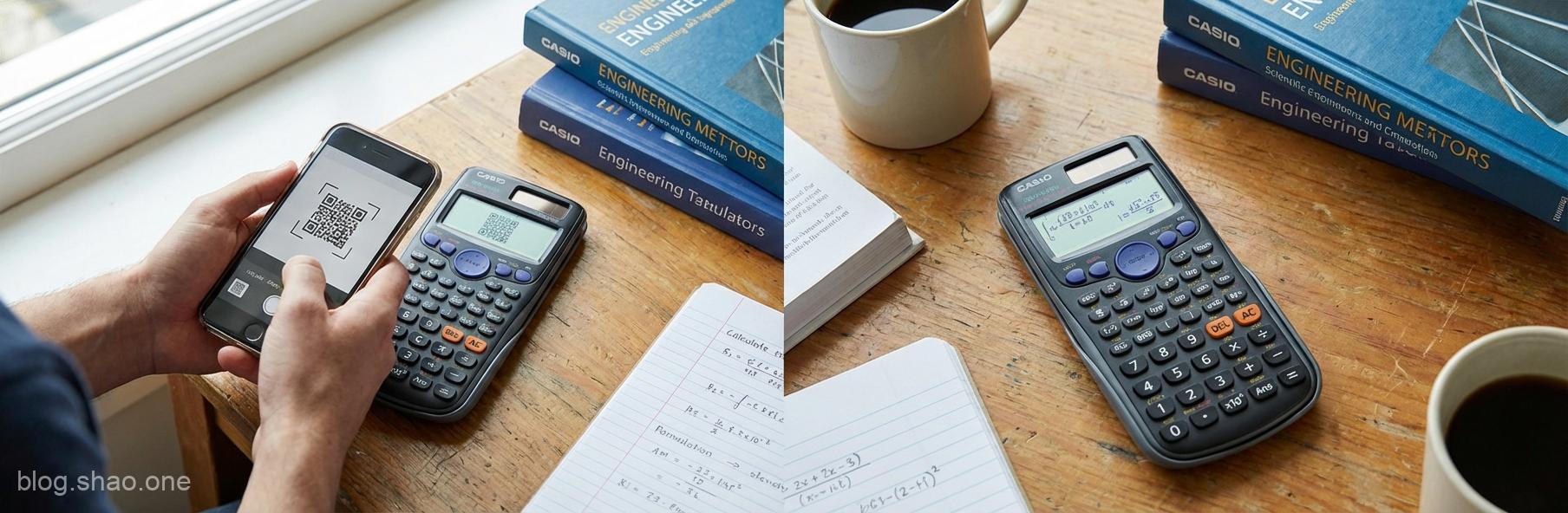
- QR Code Verification System: In recent years, genuine Casio products typically feature a built-in QR Code function. Pressing a specific key combination displays a barcode that, when scanned, connects to the official server for verification. Counterfeit products generally cannot replicate this dynamically generated verification mechanism.
- Self-test Mode: This is an "unspoken secret" within the computer community. Simultaneously pressing the
Shift + 7 + Onwill trigger a detailed hardware diagnostic interface on genuine hardware. Counterfeit systems, with their altered architecture, will typically crash or display erroneous information. - Computational Speed and Accuracy Testing: When attempting to calculate extreme values (such as extremely large factorials or complex trigonometric functions), counterfeit CPUs exhibit insufficient computational power, resulting in significantly longer processing times and even producing erroneous carry results.
💡 In-depth Commentary: This Isn't Just About "Weirdness"—It's a Crisis of Professional Trust
Why should we care about a few hundred yuan difference? In reality, this represents "scientific precision."The key difference between scientific calculators and general-purpose calculators lies in their built-in algorithms and numerical stability. For an engineer preparing for a national certification exam or an architect calculating engineering drawings, the consequences would be unimaginable if a calculator produced "a slight error leading to a huge discrepancy" during complex floating-point operations.Moreover, this also reflects the chaos within the global electronic component supply chain. Counterfeit manufacturers exploit readily available cheap chips, forcibly slapping Casio's branding onto them. This not only infringes on intellectual property rights but also turns unsuspecting consumers into unwitting victims.
📝 Summary: Don't lose the bigger picture by skimping on small expenses.
In this era of widespread e-commerce, while online shopping offers convenience, it's still advisable to purchase precision electronic instruments through "authorized distributors" or "physical chain bookstores." Products advertised as "factory direct sales" or "minor packaging damage" at unreasonably low prices are almost certainly traps.Sincere Advice from a Tech Storyteller:Buying a computer should solve your problems, not create them. Instead of purchasing a counterfeit machine that could break down or miscalculate at any moment, spend a few hundred more for peace of mind. After all, the value of your degree and professional license far outweighs that small price difference!Have you ever bought a knockoff product? Or has your Casio watch been going strong for a decade? Share your story in the comments below!“