“Hello everyone, I'm your tech correspondent! Today I'm here to share some earth-shattering news that could completely rewrite your chemistry textbooks.We've all heard the saying "true gold fears no fire." In our understanding, gold is that aloof, precious metal that never changes over centuries and doesn't just "flirt" with anyone. But in today's rapidly advancing technological world, this "ironclad rule" has been shattered!
🔬 An Unintended Discovery in the Lab: The Birth of Gold Hydrides
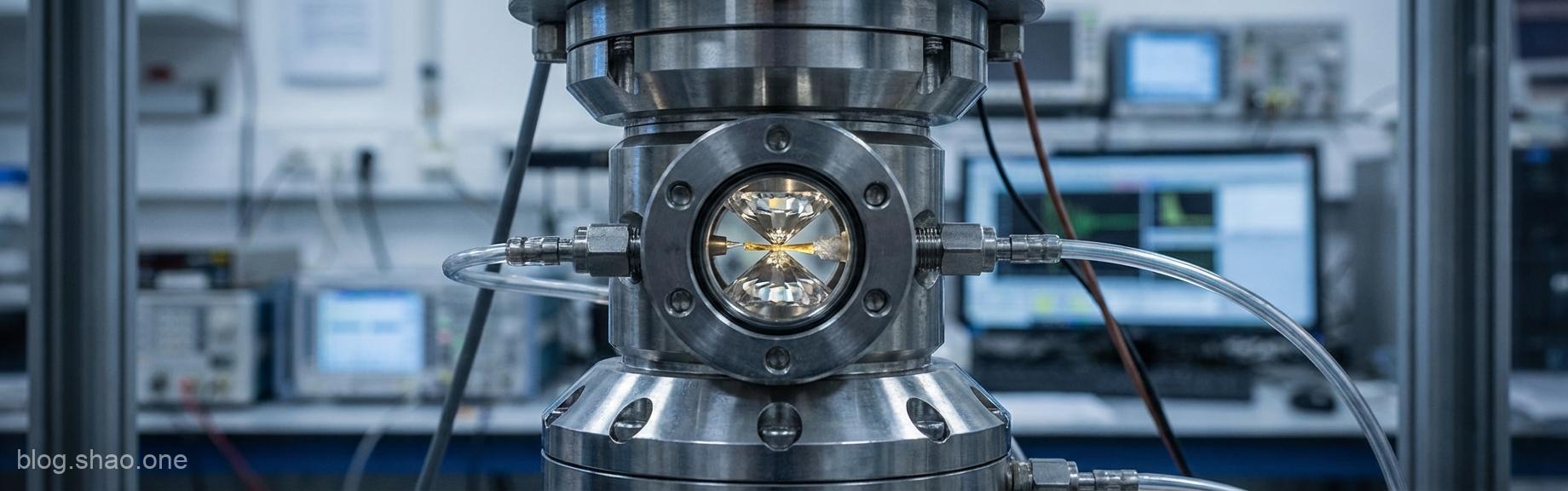
Recently, scientists from the University of Edinburgh were conducting high-pressure experiments, initially aiming only to observe how hydrogen behaves under extreme conditions. Unexpectedly, they stumbled upon a serendipitous discovery: they accidentally created an entirely new substance—gold hydride. This finding was nothing short of a blind cat catching a dead mouse, causing a major stir in the scientific community.Scientists placed an ultra-thin gold foil into a device called a Diamond Anvil Cell and injected hydrogen gas.They then subjected it to extreme compression reaching millions of times atmospheric pressure. Under this pressure—so intense even diamonds would "beg for mercy"—the normally incompatible gold and hydrogen atoms suddenly "hit it off," triggering a chemical reaction. This proves that under sufficient pressure, even the most aloof gold transforms into a "reactive metal."
💡 Three key technical highlights of this discovery:
- Dispelling the Myth of Inert Metals: Gold has long been regarded as one of the most inert elements. This experiment confirms its chemical reactivity under extreme physical conditions, posing a significant challenge to fundamental chemical theories.
- The Triumph of Extreme Pressure Technology: Scientists have used diamond anvil cells to simulate the extreme conditions found in planetary cores. This technology's precision is nothing short of a game-changer, allowing us to glimpse the ultimate mysteries of the microscopic world.
- The Development Potential of New Materials: The unique structure of hydrogenated metals holds great promise for future breakthroughs in superconductors or novel catalysts. This is no fairy tale—it's a technological revolution on the horizon.
🌍 Why does this matter to us? (Correspondent's Ramblings)
You might be thinking, "It's just a tiny sample in a lab—what does that have to do with my life?" Hey, that's where you're missing the point! The significance of this discovery extends far beyond the confines of the laboratory:
- Unraveling the Mystery of Planetary Evolution: Scientists suspect that reactions between hydrogen and metals may be commonplace within the cores of supergiant planets like Jupiter or Saturn. Understanding this reaction could transform our exploration of outer space from merely "gazing at flowers through a mist."
- The Dawn of Energy Technology: Hydrogen is hailed as the clean energy of the future, yet stable hydrogen storage remains a major challenge. Research into combining gold and hydrogen may offer fresh inspiration for hydrogen storage technology—a monumental achievement for environmental protection.
- Redefining Materials Science: This discovery reveals that humanity's understanding of matter remains merely the tip of the iceberg. Future materials science may harness pressure control to create more "black technology" substances that never existed on Earth's surface.
🚀 In the world of technology, nothing is truly impossible.
This "metamorphosis" of gold once again demonstrates the spirit of "seeking truth through science." What was once considered an established fact must now bow before more sophisticated technology. This is not merely a stroke of luck for scientists, but the culmination of years of dedicated research and accumulated knowledge in the field of materials science.Although gold hydrides currently exist only under extreme high pressure and vanish like a fleeting moment once pressure is released, this window has been opened, and future possibilities are on the verge of emerging. We stand at the threshold of a new era where physics and chemistry intertwine. Will we develop similar materials that remain stable under normal pressure? Let's wait and see!If you enjoy this kind of in-depth and engaging tech news, don't forget to keep following our channel to stay on top of the latest tech trends. Let's dive into the ocean of knowledge together and feel right at home!”