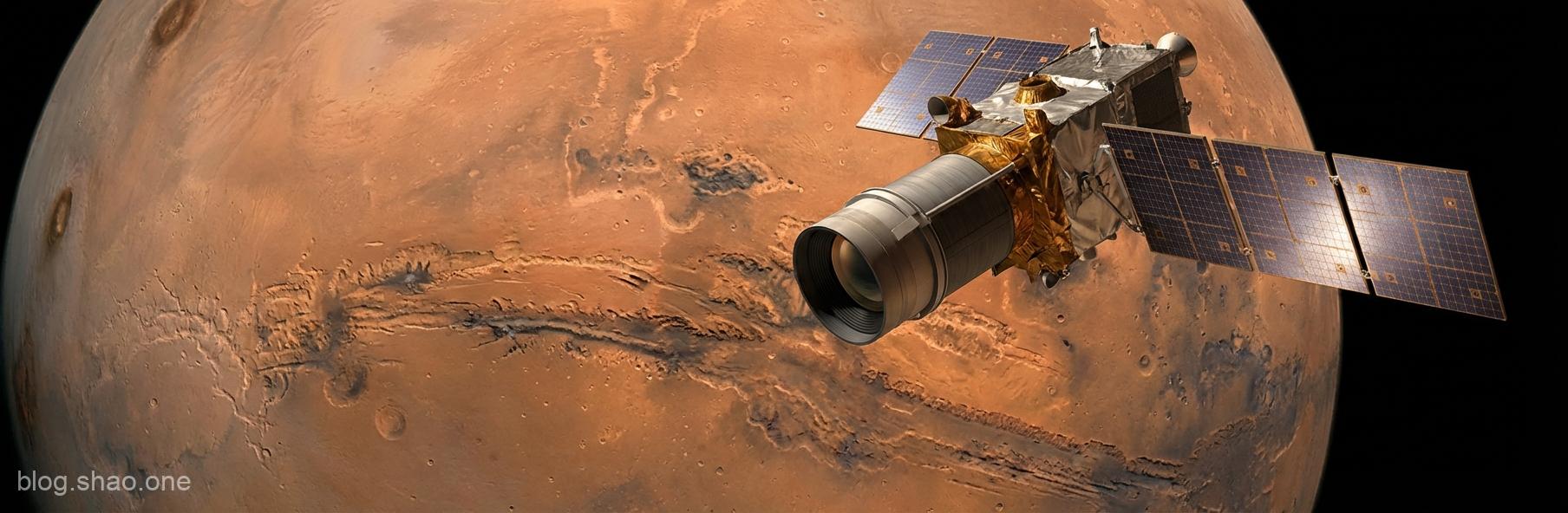
“Tech enthusiasts, the space news you've all been clamoring for is finally here! If you thought only Earth's influencers love taking photos, you couldn't be more wrong.Orbiting Mars tens of millions of kilometers away, a "veteran photography master" has just achieved a feat that puts all photographers to shame. NASA's Mars Reconnaissance Orbiter (MRO) has officially announced that its HiRISE camera has captured its 100,000th image of the Martian surface!This is far from just pressing a shutter button. Behind these 100,000 photos lies humanity's decade-long, deep-seated gaze upon the Red Planet. Today, we'll dissect the cutting-edge technology behind this "universe's most powerful single-lens camera" and why it's crucial for our future Mars colonization plans.
🎥 What on earth is HiRISE? Its resolution is off the charts.
First, let's introduce our star player. Since arriving in Martian orbit in 2006, the HiRISE (High Resolution Imaging Science Experiment) camera has been NASA's powerhouse. How powerful is it? Simply put, it boasts a resolution of 30 centimeters per pixel. This means it can clearly see an object the size of a dining table on the Martian surface from hundreds of kilometers above.
- Precision Optics: HiRISE features a 0.5-meter diameter telescope lens, making it the largest camera ever deployed on a planetary exploration mission.
- Superior Endurance: Operating reliably for over 18 years in the harsh space environment of extreme temperature fluctuations and radiation, it stands as a true "evergreen" in the tech world.
- Big Data Transmission: Transmitting this high-quality raw data back to Earth is like trying to squeeze an elephant through a narrow pipe—the technical difficulty is off the charts.
📸 The Weight of 100,000 Photos: More Than Just Scenery Shots—They're Navigation Maps
You might ask, "What's the point of taking so many photos? Isn't Mars just a pile of red dirt?" That's just you looking at the spectacle without understanding the science. Each of these 100,000 photos is a priceless treasure in the eyes of scientists:
- Pinpointing Landing Sites: From the early Curiosity to the recent Perseverance, without HiRISE's pre-flight "masterful" terrain scans to avoid boulders and craters, these billion-dollar rovers might have met their demise upon landing before achieving their mission objectives.
- Capturing Dynamic Changes: Through long-term comparisons, scientists have discovered that sand dunes on Mars move and even experience seasonal landslides. This reveals Mars not as a lifeless world, but as a dynamic "living sphere."
- Uncovering Clues to Water Sources: Numerous photographs have captured what appear to be traces of ancient river erosion, which is a tremendous boost to the search for signs of life on Mars.
💡 Expert Commentary: Why is this record so noteworthy?
As a technology observer, I believe HiRISE reaching the milestone of 100,000 images represents more than just a numerical accumulation—it showcases humanity's hard power in "remote sensing" and "durability engineering."In the harsh space environment, electronic component degradation and radiation interference are commonplace. Yet the MRO team has managed to keep this veteran instrument shining brightly—truly impressive!More importantly, most of this high-quality data is now freely accessible to the public. This democratization of science allows space enthusiasts worldwide to participate in exploration together. Gazing at Martian cliffs and craters more breathtaking than any movie special effects, one truly begins to feel that colonizing Mars may no longer be an unattainable dream.
🚀 Closing Thoughts: Will we meet on Mars for the next hundred thousand?
These 100,000 images from HiRISE have pieced together the most authentic portrait of Mars. Like a silent guardian, it circles the Red Planet day and night, solely to relay the most precise intelligence back to Earth. Though the Mars Reconnaissance Orbiter (MRO) is now an "elderly" spacecraft, it remains as vigorous as ever, continuing to pave the way for future missions.The progress of technology unfolds this way—through incremental accumulation, ultimately achieving feats that span the cosmos. Next time you gaze up at that crimson beacon in the night sky, remember that there, silently capturing the 100,001st image for us, resides the most powerful camera ever built.Let's look forward to the day—perhaps not too far off—when the lens captures not just red soil, but the bustling activity of humans building a Mars base!
This article was compiled and reported by our science correspondent. If you're also fascinated by space technology, be sure to follow our latest updates to stay at the forefront of the universe!“