“
Foreword: When Technology Meets Disaster, How Do We Race Against the Clock?
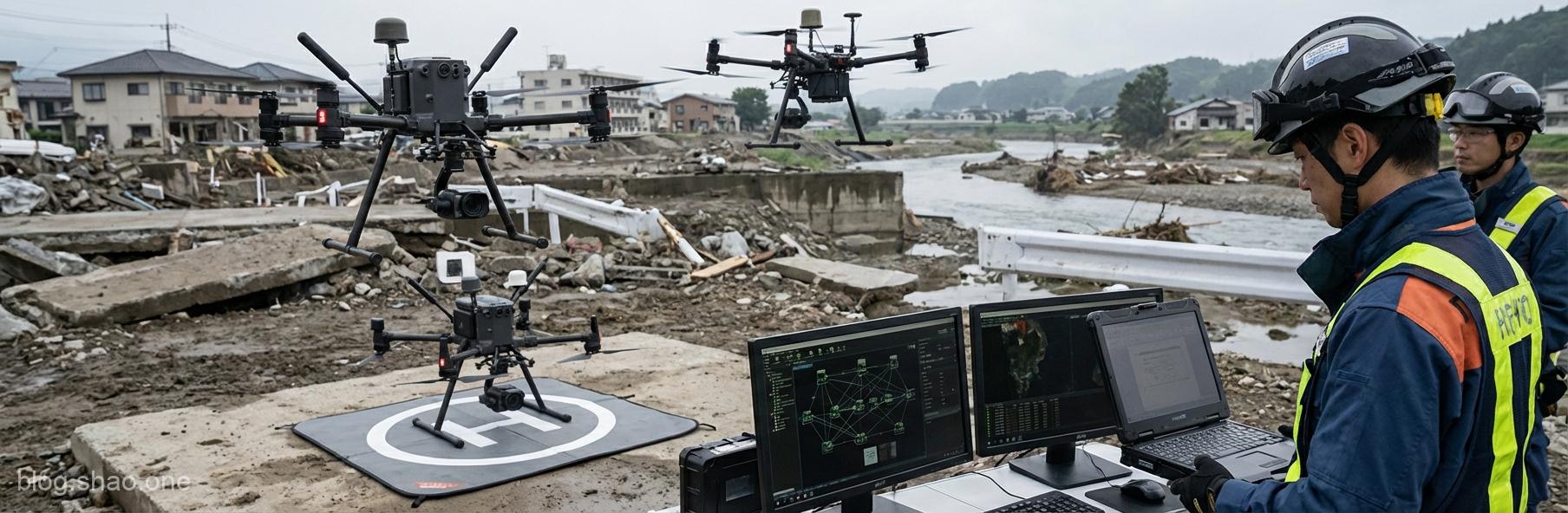
Imagine this: when a powerful earthquake or extreme weather-induced flood suddenly strikes, local cell towers topple instantly, power supplies are completely cut off, and the 5G signals and internet we take for granted vanish in an instant. In such an extreme situation where help is nowhere to be found, how can rescue teams exchange critical intelligence?Traditionally, the network transmission process we rely on is akin to transporting goods on a busy highway, constantly vulnerable to congestion or even interception by malicious actors. However, according to the latest report from Phys.org, quantum technology is offering a seamless solution to this challenge.Scientists are exploring the use of quantum entanglement technology to link swarms of drones, creating an absolutely secure and gap-free rescue communication network without requiring any traditional network infrastructure.
Quantum Entanglement: "Telepathy" Beyond Spatial Constraints
To grasp this breakthrough, one must first understand what "quantum entanglement" is. Einstein once wryly referred to it as "spooky action at a distance." Simply put, when two particles enter an entangled state, no matter how far apart they are, any change in the state of one particle will cause the other particle to respond instantaneously.
- Breaking Free from Traditional Frameworks: Traditional communication requires data to be "transmitted" via fiber optics or radio waves, but quantum entanglement enables near-instantaneous information exchange without relying on physical intermediate networks.
- Preparedness for Contingencies: This feature enables it to maintain high-efficiency operation even in disaster sites where infrastructure has been completely destroyed.
Drones: A Perfect Blend of Mobility and Technology
The most exciting aspect of this research lies in miniaturizing quantum communication equipment and mounting it on unmanned aerial vehicles (UAVs). Why are drones the ideal partners?
- Agile and versatile, they can penetrate anywhere: Drones can soar over cliffs, navigate through ruins, and excel in challenging terrain. When multiple drones form a "quantum relay station" in the air, they can create an invisible protective umbrella over disaster zones.
- Point-to-point secure link: By transmitting photons via drones, quantum key distribution (QKD) can be performed directly in mid-air, ensuring rescue instructions are delivered precisely to every corner.
The pinnacle of security: Even hackers are powerless
In today's network environment, any data transmission carries the risk of interception, especially during chaotic disaster relief operations where intelligence leaks could lead to more severe consequences. Quantum communication possesses the physical property of being "unhackable":
- Security that collapses upon contact: Quantum mechanics tells us that any act of observation alters the state of a quantum particle. If a hacker attempts to intercept quantum information mid-transmission, the data immediately becomes corrupted and triggers an alert, leaving the attacker empty-handed.
- The highest level of communication protection: For military rescue operations or the distribution of sensitive medical supplies, this undoubtedly provides a layer of "bulletproof protection."
【Expert Commentary】What is the significance of this for Taiwan and global disaster relief?
1. A Critical Step in Strengthening ResilienceFor Taiwan, situated in an earthquake zone and typhoon path, communication resilience has always been a focal point for both the government and the tech community. This research reveals that future disaster relief efforts won't require waiting for telecom companies to repair base stations—rescue teams themselves can become mobile communication hubs. This truly embodies the warmest expression of technology serving humanity.2. Break free from excessive reliance on traditional networksCurrently, our communications heavily rely on a handful of multinational telecom giants and satellite services. Quantum drone networks offer the possibility of "autonomy," enabling command systems during disasters to no longer be constrained by external factors and achieve true "self-sufficiency."3. Shorten the rescue window to save precious livesPost-disaster rescue operations rely on the so-called "golden 72 hours." If quantum drone swarms can swiftly establish stable, high-bandwidth, and secure communication links, rescue teams can promptly share 3D terrain scans or the locations of trapped individuals. This capability would undoubtedly be a game-changer for time-critical rescue missions.
Conclusion: Technological development should be people-centered.
Quantum technology may sound profoundly mysterious and elusive, yet its ultimate goal remains addressing humanity's most pressing needs. Moving from laboratories to disaster sites, the integration of quantum entanglement with drones reveals a new frontier in future disaster relief. While widespread adoption of this technology will take time, current research achievements already inspire confidence in our future disaster response capabilities.In the face of unpredictable natural disasters, we must continuously refine our technology and prepare for the worst to safeguard every shred of hope when challenges arise.”