“
The "Otherworld" Hidden Beneath the Waves
When we discuss the greatest scientific discoveries of the 20th century, most people might envision Einstein's theory of relativity or humanity's moon landing.But have you ever considered that beneath our feet, in the depths of the ocean, lies a secret capable of "shattering the heavens"? Before the 1950s, human understanding of the ocean floor was remarkably limited. Most believed it to be a flat, featureless, lifeless wasteland.Yet the emergence of scientist Marie Tharp completely overturned this perception. Armed with a pen and a stack of data, she mapped out the hidden "otherworld" concealed within the abyss.
Mary Seeley: A Scientific Pioneer Breaking Free from Stereotypes
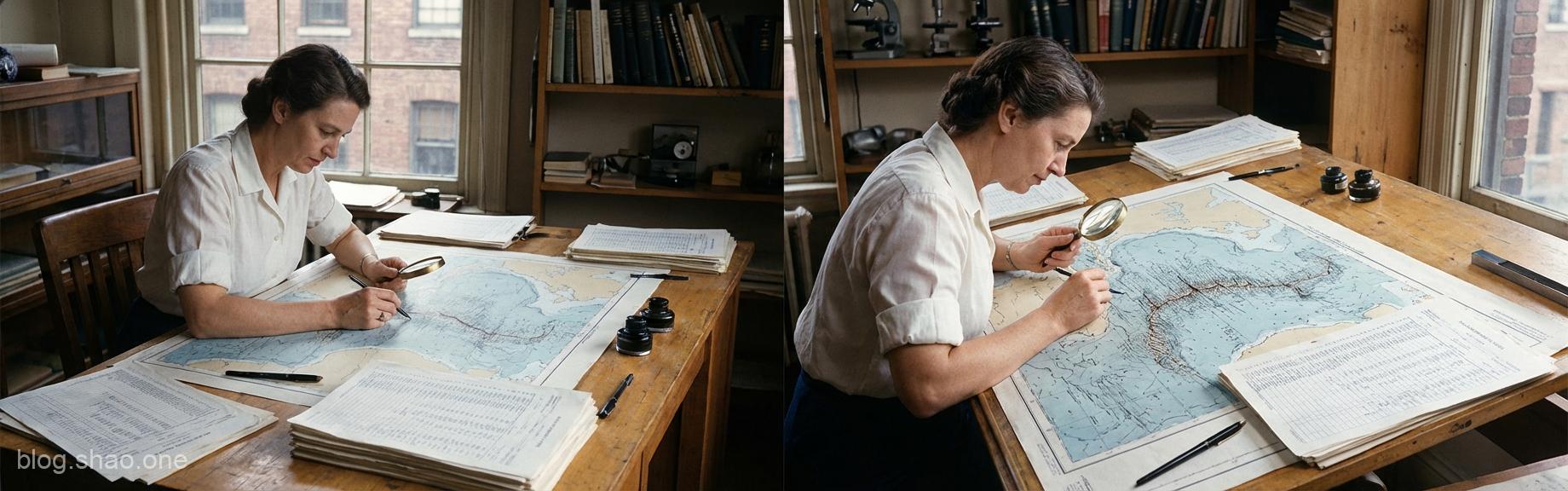
In an era when women were regarded as mere "ornaments" in the scientific community, Mary's story stands as a prime example of women proving themselves every bit as capable as men. At the time, oceanographic vessels even barred women from boarding, believing their presence would bring bad luck. This forced Mary to remain in the office, processing raw sonar data collected at sea by her colleague Bruce Heezen.To others, these data might appear as nothing more than dry, tedious numbers. But to Mary, they were the keys to unlocking Earth's mysteries. With the perseverance of grinding an iron rod into a needle, she meticulously converted thousands of water depth measurement points into topographical sketches. This work demanded not only exceptional technical expertise but also imagination and patience beyond the ordinary.
- Data Conversion Challenge: In an era without computer graphics assistance, Marie had to manually calculate and correct sonar signals, converting one-dimensional depth data into three-dimensional topography.
- The Shackles of Gender Discrimination: When she first discovered the existence of oceanic rifts, her colleagues dismissed her findings as "a woman's nonsense," labeling it a fallacy supporting the "continental drift theory"—a taboo in the scientific community at the time.
A Discovery That Shakes the Geoscience Community: The "Rift Valley" of the Mid-Atlantic Ridge
While organizing the Atlantic seafloor profile, Mary keenly noticed a distinct V-shaped depression at the center of the Mid-Atlantic Ridge.She boldly predicted that this was the so-called "Rift Valley," clear evidence that the crust was expanding outward in both directions. This discovery was nothing short of earth-shattering, as it directly validated the "theory of continental drift," which was still being ridiculed by the mainstream scientific community at the time.To prove her point, Mary persisted relentlessly, engaging in countless debates with Hysén. Finally, when they overlaid the map of undersea seismic activity onto Mary's chart, the two aligned with astonishing precision. In that moment, the veil of mystery shrouding the ocean floor was lifted. Continental drift was no longer mere speculation—it was an indisputable fact.
Technology Commentary: Why Does This Map Remain So Significant Today?
As technology commentators, we must consider: In an era of extremely rudimentary hardware, how was Mary able to produce such detailed maps that even modern satellites struggle to fully replicate? This achievement is primarily attributable to three factors:
- The Power of Data Visualization: Mary was not only a scientist but also an artist. She understood the truth that "seeing is believing." Through her masterful drafting skills, she brought abstract data to life on paper, enabling scientists to intuitively grasp the structure of the Earth's crust.
- Interdisciplinary integration skills: She combined geology, cartography, and mathematics, and this interdisciplinary approach laid the groundwork for modern big data analysis.
- Unyielding Commitment to Truth: Faced with colleagues' skepticism and suppression, she refused to go with the flow. Instead, she let the data speak for itself. This professional integrity remains the cornerstone of technological advancement in any era.
Legacy and Revelation: The Eternal Radiance Amidst the Sea of Change
In 1977, Mary and Hysén's collaborative work, The World Ocean Floor Atlas, was officially published. This vibrant, dynamic color map offered the world a fresh perspective.It was not merely a work of art, but a milestone in humanity's journey to understand our planet. Mary's story teaches us that great scientific breakthroughs often depend not on the sophistication of tools, but on whether researchers possess the "unique insight" and "unwavering courage" to see what others cannot.Today, as we effortlessly explore the seafloor topography through Google Earth, we must not forget the woman who mapped the entire ocean from her office. Though Mary Selph never achieved the same fame as her male counterparts during her lifetime, the charts she created have forever etched themselves onto the opening pages of scientific history, pulsing with the rhythms of the oceans.This is precisely the most captivating aspect of technology: it allows truths that were once hidden from view to ultimately shine brightly before the world.”