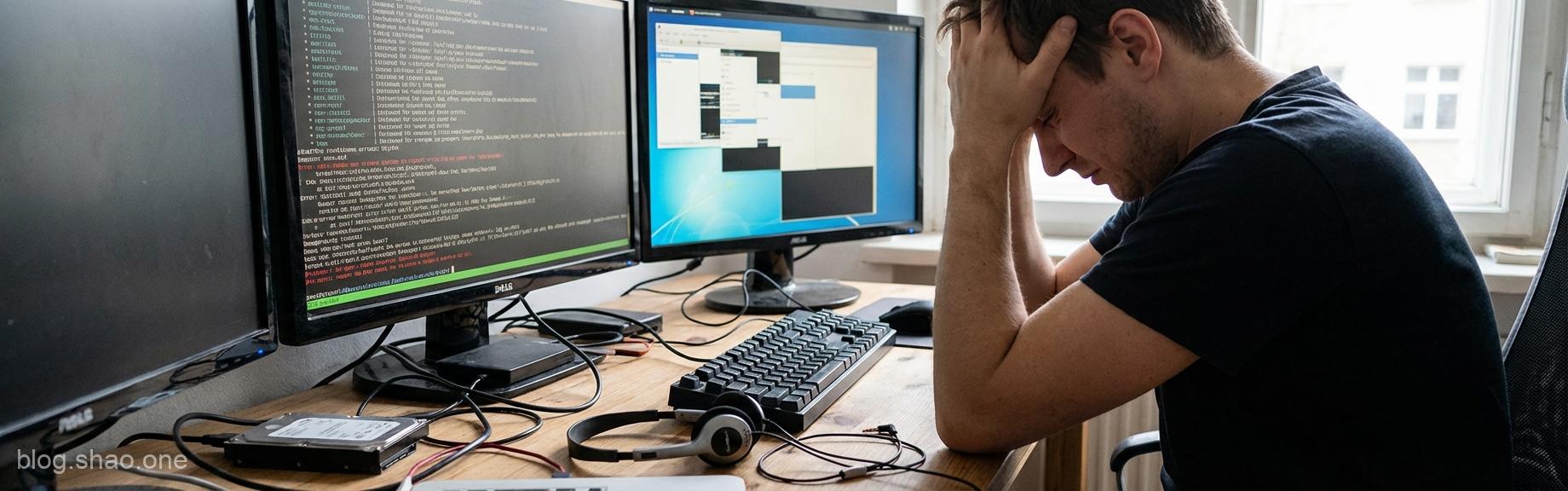
“Hello to all tech fans and software enthusiasts! In the tech world, there’s a type of \”romance\” called \”escaping the clutches of Windows and macOS\” to dive into the free, open-source, and transparent world of Linux. However, recently Terrence O’Brien, a senior editor at The Verge, published a wake-up call about his journey, bluntly titled: \”I went back to Linux, and it was a huge mistake.\” This article has sparked frantic discussion in the community. Today, we’ll deeply analyze why this \”homecoming\” trip turned into a complete disaster.
💡 Key News Summary: The Gap Between Ideal and Reality
The core argument of this column is very straightforward: \”I need an operating system (OS), not another hobby.\” Author Terrence O’Brien originally thought that today’s Ubuntu must have \”transformed\” enough to handle daily office work. But he never imagined that settings taking only seconds on Windows would require \”massive effort\” on Linux, even leading him into an endless hell of command-line troubleshooting.Here are a few fatal pain points the author encountered after returning to Ubuntu:
- Hardware compatibility is simply a \”mismatch\”: While basic drivers are fine, once it involves scaling on high-resolution displays, automatic switching for Bluetooth headphones, or advanced features of specific peripherals, Linux often falls short.
- The Terminal is a requirement, not an option: Even with the most user-friendly Ubuntu, as soon as you hit deep system issues, you still have to open that pitch-black window and type commands. For professionals who just want to focus on work, this is simply \”doing more for less.\”
- Software alternatives are \”unsatisfactory\”: Although LibreOffice and GIMP exist, for those highly dependent on the Adobe or Microsoft Office ecosystems, these open-source tools always feel like they’re missing something, even impacting cross-platform communication efficiency.
🧐 In-depth Review: The \”Achilles’ Heel\” of the Linux Desktop
From this article, we can see the deepest reflections of a tech veteran. For many engineers or hardware enthusiasts, solving the various \”odd problems\” of Linux is a sense of accomplishment; but for those who \”use computers to make money,\” this process is undoubtedly \”asking for trouble.\”1. The price of \”freedom\” is \”time\”:Linux provides unparalleled customization space, which is indeed its charm. But as the old saying goes, \”you can’t have your cake and eat it too\”—when you have ultimate freedom, you must bear the responsibility of maintaining the system. In Windows, an update might solve everything; in Linux, an update might prevent you from even entering the graphical interface. This is the true meaning of the author’s statement that \”Linux is another hobby.\” You have to spend time maintaining and nurturing it, which for busy modern people, is simply too costly.2. The ideal is full, but reality is bare:We often say \”the spring of Linux is coming,\” especially after the launch of the Steam Deck. But reality is that mobile gaming handhelds and \”general desktop office work\” are two completely different things. Valve allows players to use Linux seamlessly through the finely tuned SteamOS, but when you try to install Ubuntu on a standard laptop for multitasking and creation, those trivial compatibility issues pop up like \”mushrooms after rain,\” catching you off guard.3. A feeling of disappointment:The author doesn’t hate Linux; on the contrary, he returned with love, only to have a bucket of cold water thrown on him by reality. This feeling of disappointment reflects a long-term gap in UX (User Experience) design for the Linux desktop. Developers focus more on the stability and freedom of the underlying architecture but fall short when it comes to \”humanized operation.\”
🚀 Advice for Readers: Are You Suited to Take the Plunge?
If you are also considering \”leaving the dark for the light\” and switching to Linux, after reading this report, you might want to ask yourself: Do you want a \”worry-free tool\” or a \”toy you can study\”?
- If you are a developer or server administrator: Linux is definitely your paradise; you will be in your element there, pushing system performance to the limit.
- If you are a general business professional or creative worker: I suggest thinking twice. Unless you are ready to \”change careers mid-stream\” to learn Bash commands, staying with Windows or macOS is safer. Don’t sacrifice your work schedule for a bit of \”open-source sentimentality.\”
In conclusion, this article from The Verge is not badmouthing Linux, but rather reminding us: The essence of a tool is to serve people, not for people to serve the tool. When an operating system makes you feel like you’re \”busy with nonsense\” rather than \”increasing productivity,\” perhaps returning to those familiar windows is the smartest choice.Do you have experience trying Linux only to meet your Waterloo? Or are you a loyal Linux supporter who thinks the author is just overreacting to common issues? Feel free to leave a comment below to share your perspective. See you next time!”