“Hello everyone, welcome to today’s Technology and Trend Observation. The topic we’re discussing today might give you the chills; it’s not a ghost story, but a real public health crisis happening on the other side of our global village. According to the latest report from ZME Science, a mysterious and fatal virus has recently appeared in Bangladesh. Its mortality rate and transmission methods have scientists saying that things have taken a very serious turn.
🔴 Mysterious Outbreak in Bangladesh: This Is No Ordinary Cold
Between late 2022 and early 2023, hospitals in Bangladesh saw a series of five patients with extremely severe symptoms. At first, these patients seemed to have just an ordinary fever and difficulty breathing, but their conditions worsened so quickly that doctors were caught off guard. This wasn’t just a common flu; it’s the notorious Nipah Virus (NiV).What is the Nipah virus? Simply put, it is one of the priority viruses monitored by the World Health Organization (WHO) because not only is its mortality rate extremely high, but currently there is no cure and no vaccine available. In the cases that broke out in Bangladesh this time, the patients’ disease progressed rapidly, and some even developed dangerous encephalitis (brain swelling), which in medical terms is like a ‘tug-of-war with the Grim Reaper.’
🦇 Trouble Enters Through the Mouth: That Mysterious ‘Extra’ in the Juice
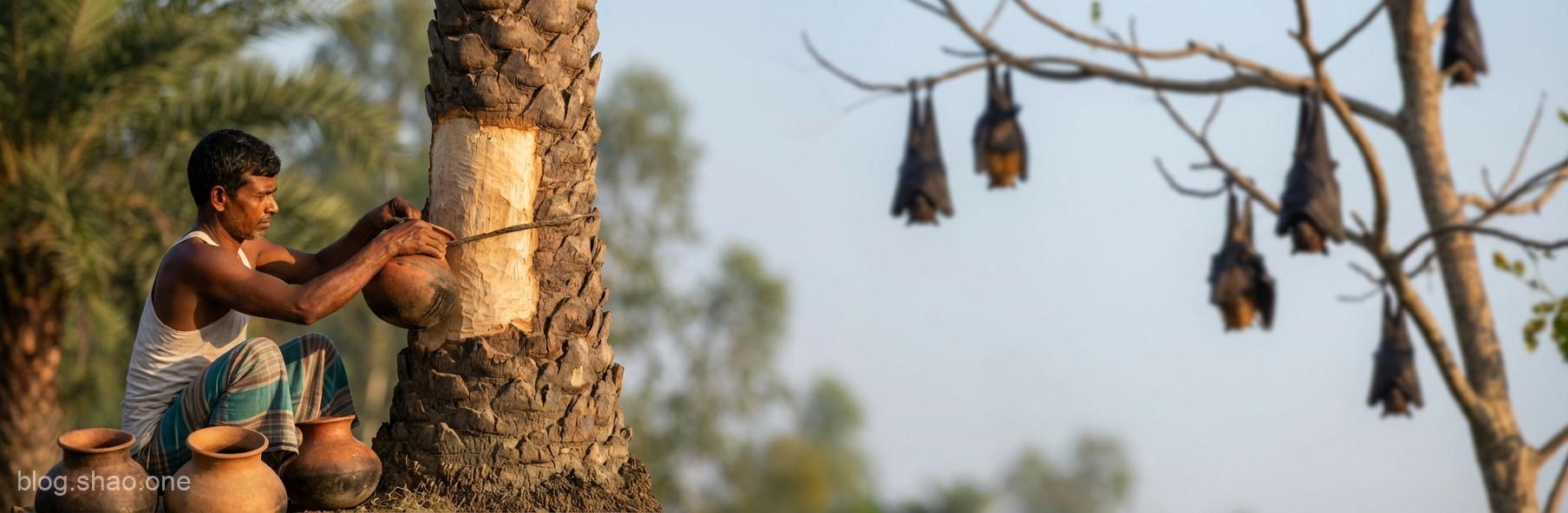
Why did this virus suddenly come knocking? Scientists traced the source and found that the problem lies in a traditional local beverage—Raw Date Palm Sap. In Bangladesh, collecting date palm sap is a tradition where workers cut notches into tree trunks to let the sap flow into collection jars.However, there’s a catch: local fruit bats also love this drink. When these bats steal a drink in the middle of the night, they leave behind saliva, urine, and even feces. If locals drink this raw sap directly without knowing the risks, they are essentially drinking the virus. This is a classic case of ‘disease entering through the mouth’ and is the main reason for the recurring Nipah outbreaks in the region.
🔍 Why Do We Need to Be Extra Vigilant This Time?
The key point highlighted in this report is that the level of threat from the Nipah virus seems even ‘fiercer’ than we imagined. Here are a few key points:
- Terrifyingly High Fatality Rate: Past data shows that the mortality rate of the Nipah virus is between 40% and 75%. But in some cluster infections in Bangladesh, the death rate often approaches the upper limit, which is essentially ‘playing with one’s life.’
- The Hidden Concern of Human-to-Human Transmission: Although it is currently transmitted mainly through bats, scientists have discovered that the Nipah virus already possesses the ability for human-to-human transmission. If the virus evolves to become more stable, the consequences would be simply unthinkable.
- Diagnostic Difficulty: The early symptoms of the Nipah virus are very similar to a common cold or Dengue fever. If medical staff do not notice it immediately, it can easily lead to hospital-acquired infections, causing the lines of defense to ‘collapse like a mountain.’
💡 Tech Perspective: How Do We Respond to This Silent War?
As technology observers, we shouldn’t just watch the spectacle but also look for the underlying principles. This epidemic has given us several important revelations:
- The Importance of Early Warning Systems: Through big data and AI monitoring of environmental changes (such as the shrinking of bat habitats), we can predict the possibility of outbreaks in advance and ‘nip them in the bud.’
- The Biotech Race: Vaccine development for the Nipah virus is currently underway, but progress is slow. This reminds us that when facing pandemic-potential diseases, global R&D investment must never be ‘abandoned halfway.’
- Infrastructure and Education: Improving local collection equipment (such as adding protective nets to collection jars) and educating the public not to drink raw sap are the most immediate actions. After all, the old saying ‘prevention is better than cure’ applies in any era.
📝 Conclusion: Don’t Let ‘Bats’ Tears’ Become a Human Tragedy
Although Bangladesh is quite far away, in today’s highly globalized world, everything is connected. From the experience of COVID-19, we have learned that unknown viruses from any corner of the world can sweep across the globe in a short time. The appearance of the Nipah virus is undoubtedly another wake-up call for humanity.While we pursue technological progress, we must also learn to respect the balance of nature. If we continue to encroach on the habitats of wild animals, the frequency of these ‘mysterious viruses’ appearing will only increase. In short, facing unknown threats, we must remain vigilant so that we are not caught unprepared when the next pandemic arrives.That’s all for today’s share. What are your thoughts on this mysterious virus? Feel free to discuss with us in the comments section!”