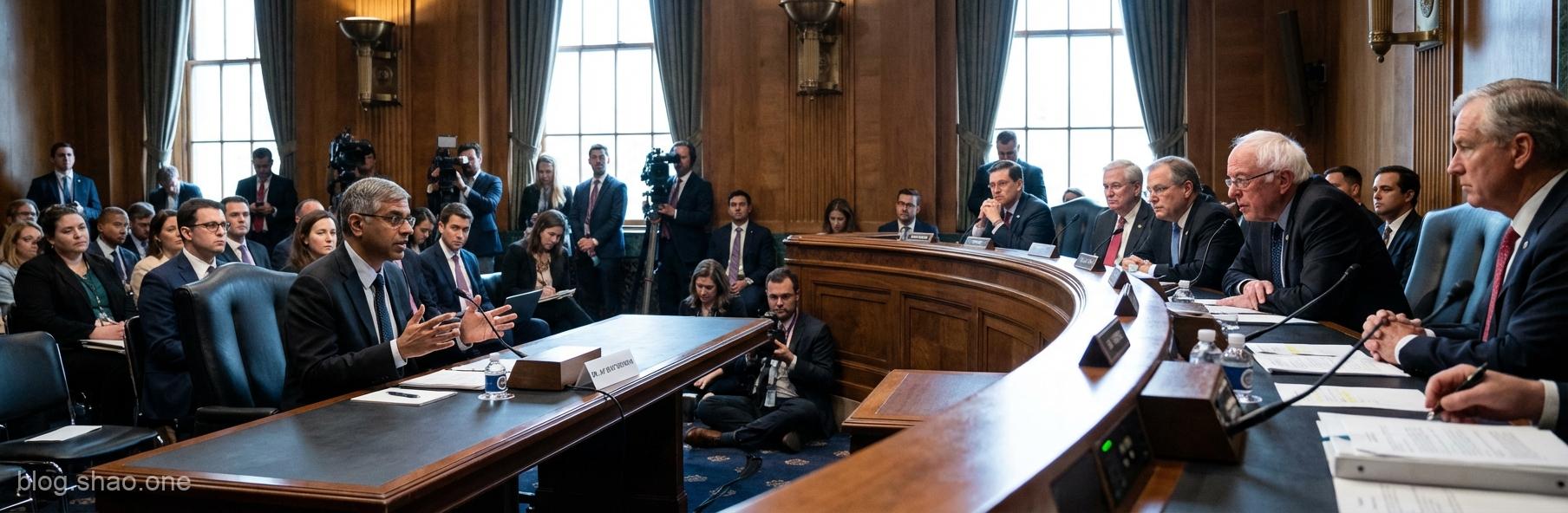
“In this era of information explosion, progress in technology and biomedicine should lead humanity toward a healthier future. However, sometimes the entanglement between politics and science is even more dramatic than a soap opera. A recent hearing on Capitol Hill has stunned the global public health and biomedical communities. The protagonists of this ‘clash of the titans’ are the newly appointed Director of the US National Institutes of Health (NIH), Jay Bhattacharya, and his superior—the nominee for Secretary of Health and Human Services, Robert F. Kennedy Jr. (RFK Jr.).
💡 Event Core: When Science Meets the ‘Hard Truths’ of Politics
The trigger for this drama was the ‘rapid-fire questioning’ from veteran Senator Bernie Sanders. At the hearing, Sanders cut straight to the core, asking the Director-to-be of the world’s largest biomedical research institution: Do vaccines actually cause autism?Bhattacharya did not choose a vague, ‘squeezing-toothpaste’ style response, but instead went for a ‘direct confrontation.’ He stated clearly that he does not believe a causal relationship exists between vaccines and autism. This statement caused a massive stir because his boss, RFK Jr., has for years been the standard-bearer for the theory that ‘vaccines cause autism.’ This scenario of a ‘subordinate publicly contradicting a superior’ is extremely rare in the political arena.
📌 Key Summary and Deep Analysis
Below, we have summarized the three key battlefields of this hearing and their profound significance for the technology and medical sectors:
- The Defense of Scientific Integrity:Bhattacharya emphasized during the meeting that NIH decision-making must be built upon ‘evidence.’ For the biomedical community, this is undoubtedly a reassuring pill. If the conclusions of scientific research depend on the whims of politicians, who would dare use the resulting drugs or vaccines? This is not just an academic issue; it is a matter of integrity concerning human lives.
- The Information Dilemma of ‘A Lie Repeated Often Enough’:The views long-disseminated by RFK Jr. have circulated widely on social media, forming an ‘echo chamber’ where believers remain convinced. When pseudoscience is accelerated through digital technology, true scientific data often moves slower than rumors. This dialogue reflects the current difficulty in public health communication—even when evidence is ‘ironclad,’ overturning the public’s established impressions remains incredibly difficult.
- NIH Budget and Independence:As an agency managing tens of billions of dollars in budget, the direction of the NIH directly impacts the global biotech industry. If Bhattacharya insists on scientific neutrality, will he clash with the Department of Health and Human Services in a ‘cross-talk’ of contradictions? For many biotech startups relying on NIH grants, future policy variables are ‘terrifying to contemplate.’
🔍 Author’s View: Science is Not a Case of ‘He Said, She Said’
In Taiwan, we often say ‘seek truth from facts,’ but at the two ends of the political spectrum, facts are often interpreted differently. While Bhattacharya’s stance this time preserved the integrity of a scientist, it also laid the groundwork for future administrative friction. This is not just a debate about vaccines, but an ultimate showdown between being ‘Data-driven’ and ‘Ideology-driven.’For technology enthusiasts, what we should focus on is: when leaders of public trust institutions are forced to pick a side between political pressure and laboratory data, how can we use technological means (such as blockchain to track experimental data or AI-assisted literature review) to guard the truth? If even the Director of the NIH faces pressure to ‘lie with his eyes open,’ then the general public needs even more ‘immunity’ against fake news when interpreting health information.
🚀 Conclusion: The Show Has Just Begun
This hearing is only the prelude. How the NIH will operate under the leadership framework of RFK Jr. currently appears to be a case of ‘crossing the river by feeling the stones.’ This tug-of-war between science and politics is being watched not only by the US but by the global biomedical community with bated breath. After all, on the road to pursuing truth, what we fear most is someone ‘playing matchmaker poorly’ and forcibly linking unrelated data.Dear readers, do you think scientists should remain neutral in the political arena, or should they be more actively involved in policy-making? Welcome to leave a comment below and share your views with us!”