“
🛑 Breaking News: Seattle Airport’s ‘Red Alert’
Recently, Seattle-Tacoma International Airport (Sea-Tac) reported news that has left the public health sector trembling. A passenger confirmed to have measles crossed paths with thousands of travelers during the arrival and departure process. According to the latest report from Snohomish County health officials, this outbreak appears to have a widening trend, forcing the epidemic prevention system—already overwhelmed by various viruses—to face yet another major challenge.For many tech enthusiasts, this might just be another piece of social news. However, if you look closely at the logic behind it, this is actually a real-world exercise in ‘data tracking’ and ‘biotechnology.’ In modern society, the speed of virus transmission is already as fast as a 5G network; we cannot simply be stubborn and think we are safe; we must rely on the power of technology for ‘proactive deployment.’
🛡️ Tech Perspective 1: The ‘Divine Prediction’ of Big Data and AI Algorithms
The most difficult part of this measles case is the high volume of passenger traffic at the airport. Traditional epidemiological investigation methods rely on ‘face-to-face interviews,’ but in this information-saturated age, such an approach has clearly ‘fallen far behind.’
- Importance: By utilizing airline booking data, airport surveillance footage, and mobile signal positioning, data scientists can use AI algorithms to simulate the potential spread paths of the virus. This isn’t a movie; it’s ‘precision epidemic prevention’ in action.
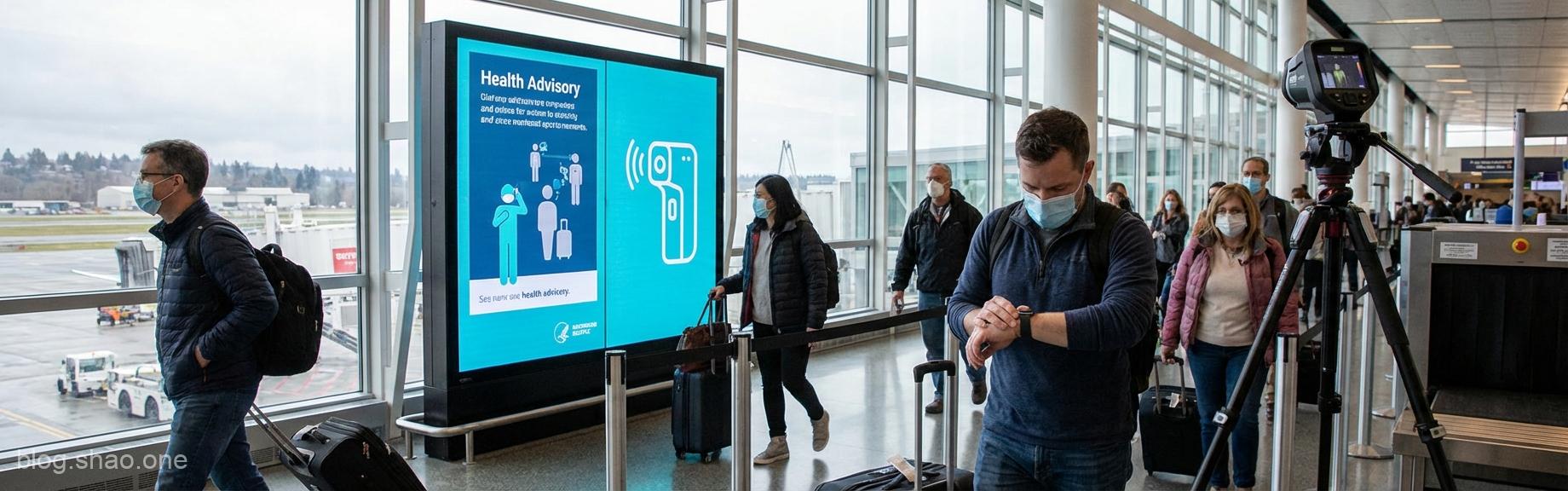
- Author’s Perspective: Future airports might fully implement non-contact thermal imaging and biometric identification, allowing hidden risks to be intercepted before they ‘come to light.’ Although this involves privacy controversies, how to find a balance in the face of public health safety is a topic tech professionals must ponder.
🧬 Tech Perspective 2: The ‘Protective Shield’ of mRNA and Synthetic Biology
Measles is terrifying because of its extreme contagiousness; as long as someone in a confined space is infected, almost everyone without antibodies will ‘hit the jackpot.’ In such times, the research and development of biotechnology become crucial.
- Importance: Since COVID-19, mRNA technology has proven its potential for ‘rolling updates.’ Facing measles or other variant viruses, modern biotech companies can adjust vaccine formulas in an extremely short time; this is essentially the ‘Protective Pillar’ of the public health world.
- Author’s Perspective: This Seattle case reminds us that the integration of Bio-tech and Information Technology (IT) is an inevitable trend. Without powerful computing capabilities to support protein folding analysis, we simply cannot develop countermeasures before a virus spreads.
📡 Tech Perspective 3: Wearable Devices and Digital Health Monitoring
Imagine if this traveler were wearing the latest smartwatch and had authorized health data tracking—could the system have issued a warning the moment their body temperature rose abnormally or their heart rate became irregular?
- Importance: Wearable devices are no longer just toys for counting steps; they are the ‘first line of defense’ for health. Through real-time uploading of physiological data and cloud analysis, we can identify potential carriers earlier, preventing an outbreak from reaching an ‘irreparable’ stage.
- Author’s Perspective: Although the combination of digital health passports and the Internet of Things (IoT) will face many challenges from ‘cynics’ during implementation, in the long run, this is the only way to enhance global public health resilience.
💡 Conclusion: The ‘Grounded’ Fusion of Technology and Life
This measles case at Seattle Airport is by no means a simple, isolated public health incident. It serves as a wake-up call, reminding us that while we enjoy the convenience of air travel, we must also upgrade our ‘epidemic prevention equipment.’For the tech community, we cannot just spend all day thinking about how to develop the next viral social app. Truly integrating AI, Big Data, and bioengineering to solve threats to human survival is the ‘real deal.’ I hope this outbreak can smoothly drive more cross-domain cooperation, rather than waiting until the ‘fire is at our backs’ to think about a solution.In this ‘multi-hyphenate’ era, epidemic prevention is not just a doctor’s business; it is the responsibility of every tech professional. Let us look forward to a future where technology can make these infectious disease cases ‘disappear,’ returning to the public a sky where they can fly with peace of mind!”