“
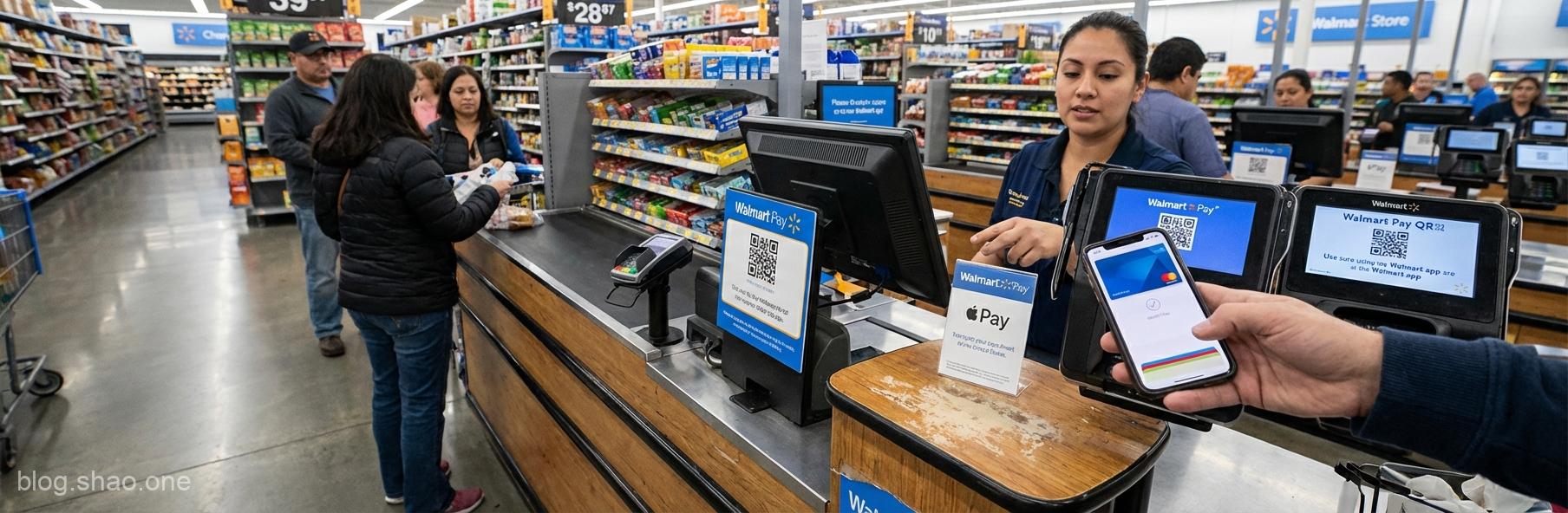
The Tug-of-War Between Tech Giants and Retail Leaders: Why Does Apple Pay Still “Hit a Wall” at Walmart?
Time flies, and even by 2026, when you step into the doors of the U.S. retail leader Walmart and prepare to check out, pulling out your iPhone for a stylish “contactless payment,” the reality might leave you very disappointed. Although Apple Pay has long been popularized worldwide—with even street vending machines supporting it—Walmart has remained determined, and to this day, it is one of the very few large chain stores in the U.S. that refuses to allow Apple Pay. Why exactly is this?This is not just a technical debate about payment tools, but a deep-seated game involving data sovereignty, fee power struggles, and corporate ecosystems. Below, we will break down the key reasons behind this:
1. Data is Wealth: Walmart’s “Hidden Agenda”
For Walmart, customer spending behavior data is a gold mine. When you use Apple Pay to check out, Apple’s technology protects privacy through virtual card numbers, which means Walmart cannot easily link this transaction directly to your personal identity, making it difficult to track your purchase habits, frequency, or preferences.
- Data Control: Walmart wants to own a complete data closed loop. Through its self-developed Walmart Pay (based on QR code scanning), they can precisely track “what” every customer bought, “when” they bought it, and “how often” they purchase.
- Precision Marketing: By mastering this data, Walmart can push more attractive personalized offers in its own app. For them, this is an essential strategy, and they are absolutely unwilling to hand over this “choice meat” to others.
2. Meticulous Calculation of Fees: Every Penny is Key
Profit margins in the retail industry are often as thin as a cicada’s wing. For a giant like Walmart with such massive volume, the credit card transaction fees (Interchange Fees) incurred with every transaction represent a staggering expenditure.
- Fee Costs: Although Apple Pay itself does not charge merchants, it drives the popularity of contactless credit cards. Walmart is more inclined to promote its own financial products (such as the Walmart co-branded credit card) or payment methods directly linked to banks, thereby reducing intermediary costs in the payment process.
- Refusing to be “Taxed”: Although Apple Pay’s current operation is not much different from physical card swiping, Walmart has always remained wary of tech giants intervening in the payment process, fearing they might be further restricted or charged extra fees in the future. This precautionary mindset has kept them hesitant about promoting NFC payments.
3. Walmart Pay’s Ecosystem Moat
Walmart doesn’t just want to reject Apple Pay; more importantly, they want to promote their own payment ecosystem. The unique Walmart Pay does not use NFC technology, but rather the more traditional QR code scanning. While this seems a bit “retro” technically, it has its strategic brilliance:
- Cross-platform Compatibility: QR code payments can be used easily on both iPhone and Android phones without worrying about NFC chip restrictions.
- Integration of Member Services: Walmart Pay perfectly integrates checkout, electronic receipts, member discounts, and the return process. Walmart believes that compared to simple “contactless payment,” this all-around digital experience can better retain customers and make the relationship between consumers and the brand unbreakable.
4. Industry Commentary: The Tug-of-War Between Consumer Experience and Business Interests
For the average tech enthusiast, Walmart’s approach is clearly less than ideal. In an era where efficiency and convenience are sought after, consumers have become accustomed to the “tap-and-pay” experience, and Walmart’s insistence on users opening an app to scan a barcode undoubtedly increases operational “friction.”
- Market Reality: As former “resisters” like Kroger and CVS have compromised one after another, Walmart now stands almost alone. Although they hold near-monopoly bargaining power in the U.S. retail market, it remains an unknown how long this persistence can be maintained.
- Future Variables: If consumer dissatisfaction reaches a breaking point one day, or if Apple makes some concession regarding data sharing, this iceberg might finally melt.
Conclusion
In conclusion, Walmart’s refusal to support Apple Pay is not due to a lack of technical capability, but rather a business strategy based on shrewd calculations. They would rather sacrifice some checkout convenience to ensure data integrity and the closed nature of their ecosystem. In this game between technology and retail, who will have the last laugh? Will it be Walmart, sticking to its own path, or Apple, continuing to expand its territory? Let us wait and see.Reader Feedback: If your local supermarket didn’t accept Apple Pay, would you switch to another store for that reason? Or would you tolerate the inconvenience for the sake of saving money or specific products? You are welcome to leave a comment below and share your views!”