“
Foreword: Plans can’t keep up with changes; the speed of virus mutation is startling
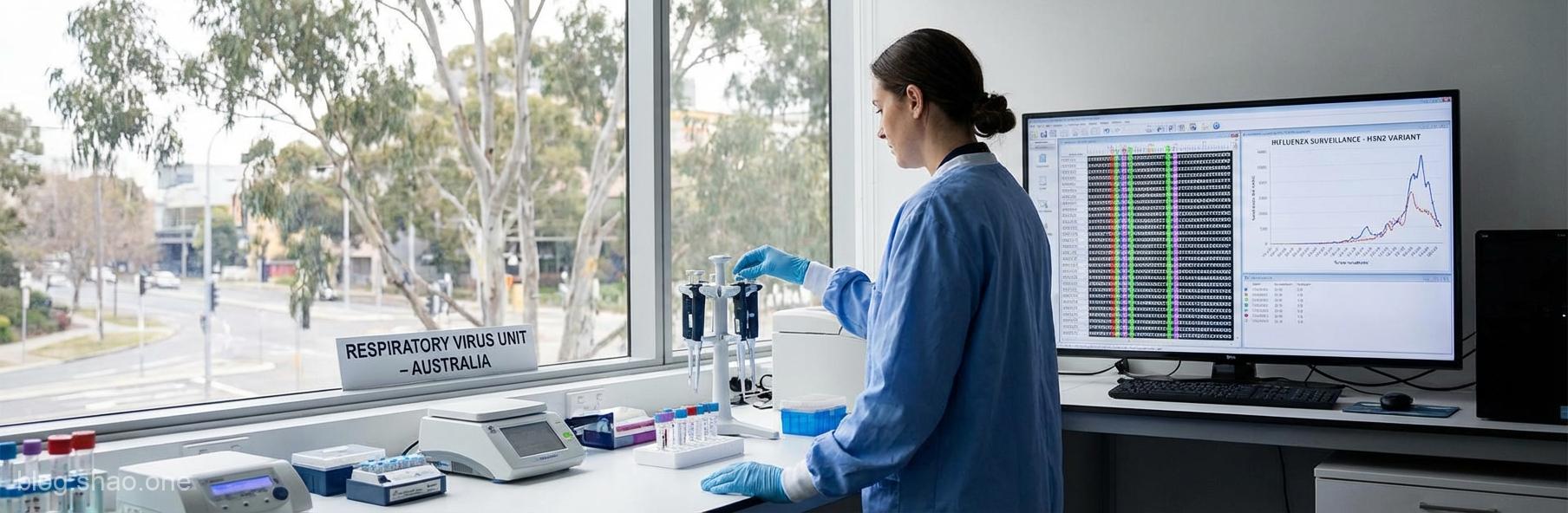
In this era of rapid technological advancement, we always think humanity has reached the pinnacle of biotechnology. However, nature always seems to play jokes on us. As the saying goes, \”an unexpected hurdle appears halfway.\” While the world is still recovering from the shadow of COVID-19, a flu variant codenamed \”Super-K\” (Super-K) is quietly spreading in Australia and even globally. This is not just a medical challenge, but a \”litmus test\” for our technological pandemic prevention network.According to the latest reports from Australia’s SBS News, this flu variant, known as \”subclade-K,\” is showing transmission characteristics different from the past. As tech news observers, we cannot just look at surface data; we must delve into the biotechnological chess game behind it.
The Emergence of \”Super-K\”: What kind of \”Virus Monster\” is this?
First, let’s clarify: what exactly is this \”Super-K\” that has experts calling it \”unusual\”?
- Nature of the Virus: Epidemiology professor Adrian Esterman points out that \”Super-K\” is actually a \”drifted version\” of the H3N2 virus we are familiar with. Simply put, it’s like an old rival putting on a \”new coat,\” making it temporarily unrecognizable to our immune systems.
- Drift Phenomenon: In virology, this phenomenon is called \”antigenic drift.\” The virus undergoes minor mutations during replication. Although it’s the \”same old soup with different ingredients,\” it’s enough to significantly reduce the effectiveness of previous vaccines.
- Transmissibility: Currently, this strain of the virus has been observed to spread extremely quickly in Australia, even showing a trend of replacing existing mainstream strains. It can be said that \”the visitor does not come with good intentions.\”
This is undoubtedly a warning to us: even if we have advanced medical systems, we must never \”let our guard down\” in the face of such \”unpredictable\” natural evolution.
Why is it called \”Unusual\”? Red Flags in the Eyes of Experts
The reason Australian experts have labeled it \”unusual\” is that its evolutionary path has exceeded original prediction models. In the past, flu vaccine development could often \”prepare for a rainy day\” by predicting the next season’s mainstream strains in advance. However, the emergence of \”Super-K\” is like playing a game of \”hide and seek\”; its minor changes in genetic sequence have resulted in significant immune escape.This indicates that traditional monitoring methods may already be \”falling short.\” The speed of viral evolution is \”covering a thousand miles a day.\” If we continue to use old response mechanisms, we are likely to fall into a predicament of \”total defeat.\” This is precisely why the World Health Organization (WHO) and tech laboratories in various countries are racing against time, attempting to use big data and AI to crack its genetic code.
Tech Review: Can AI and Gene Sequencing Become Our \”Guardian Pillars\”?
Faced with the threat of \”Super-K,\” the tech world is not helpless. In fact, this is the best time to demonstrate that \”to do a good job, one must first sharpen one’s tools.\” Here are the highlights of how the tech world is responding:
- High-Throughput Gene Sequencing (NGS):Through next-generation sequencing technology, researchers can identify subtle differences between \”Super-K\” and standard H3N2 in an extremely short time. This is like giving us a pair of \”Fiery Eyes,\” leaving the virus’s disguise with nowhere to hide.
- AI Prediction Models:Utilizing artificial intelligence to simulate the protein folding process, experts can predict which mutation sites are most likely to lead to vaccine failure. Although \”plans can’t keep up with changes,\” AI can help us calculate a few steps ahead and \”prevent problems before they occur.\”
- Flexibility of mRNA Vaccine Platforms:Since the virus can change its outfit, our vaccine production must also \”adapt to changes.\” The greatest advantage of mRNA technology is that once a new sequence is identified, the vaccine formula can be adjusted within weeks. This \”on-demand\” response capability is something traditional vaccine craftsmanship can only dream of.
Short Comment: Although virus mutation is \”commonplace,\” through technological means, we can turn from passive targets into proactive defenders. The current tech race is actually a \”race against time.\”
Conclusion: Pandemic Prevention is Warfare; Only by \”Staying Alert\”
In summary, the emergence of \”Super-K\” flu reminds us: in today’s globalized world, no single country can \”stand alone.\” An outbreak in Australia could very well spread to Taiwan in a matter of days. This is not only the responsibility of government public health departments but also information that every citizen needs to pay attention to.Facing a virus, we don’t need to \”be paranoid at every sound,\” but we must \”be prepared for danger in times of peace.\” Technology has given us more powerful tools, but ultimately, it requires human vigilance and action to coordinate. Hopefully, in the near future, we can use more mature AI monitoring networks to \”nip such mutant viruses in the bud.\”Tech News Curator’s Musings:In this era of information explosion, understanding virus mutations is not for creating panic, but to make us better prepared. Next time you go for a flu shot, don’t forget that behind it lies the \”crystallization of hard work\” from countless scientists and supercomputing centers! \”Killing two birds with one stone\”—while understanding tech trends, why not protect your health at the same time?”