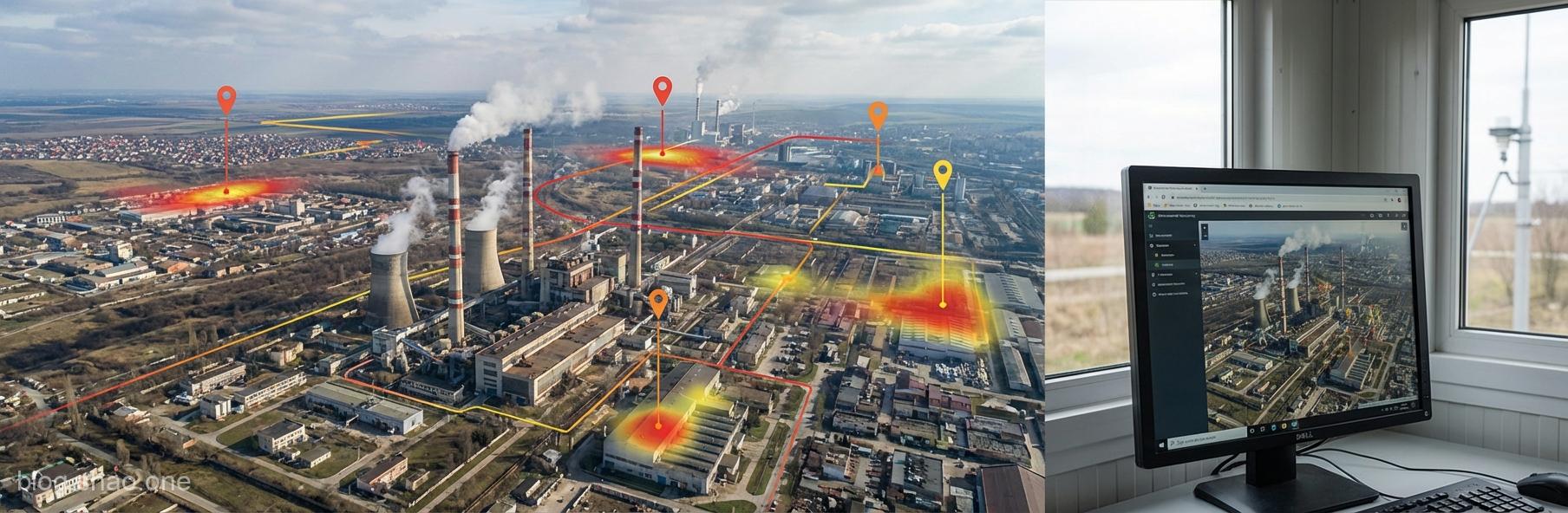
🌍 Foreword: The Invisible Enemy, Now Crystal Clear
As the saying goes, ‘Know yourself and know your enemy, and you will never be defeated,’ but in this long battle against climate change, we often don’t even know where the enemy is or what they look like. Carbon dioxide (CO2) is invisible and intangible. For a long time, many big carbon emitters have held an ‘out of sight, out of mind’ attitude, hiding in the gray areas of statistical data. But now, technological developments are leaving these emitters with ‘nowhere to hide.’
According to the latest report from Gizmodo, the US is now able to mark the most serious carbon pollution sources on a map with ‘incredible precision.’ This is not just a breakthrough in scientific research, but a declaration to the public: carbon emission is no longer a matter of creative accounting; when it comes to who is polluting, the data has the final say!
🔍 The Data Mirror: Why ‘Precision’ is Key?
In the past, our understanding of carbon emissions mostly stayed at macro data at the national or state level, much like looking at a ‘stew’—you know there’s meat and vegetables inside, but you don’t know which specific piece of meat has gone bad. The research and data tools mentioned this time are like installing a ‘microscope’ and a ‘truth-revealing mirror’ for the Earth.
- Precision Strike on Pollution Sources: Through satellite monitoring, ground sensors, and big data algorithms, it is now possible to track specific power plants, factories, and even particular industrial facilities. This ‘meticulous’ spirit turns data from cold numbers into ‘evidence’ with legal and social responsibility.
- The Power of Transparency: As stated in the report, ‘American taxpayers have the right to know this data.’ When data is visualized into a clear map, big carbon emitters can no longer ‘muddle through,’ and the public can directly see exactly who is polluting the air near their doorsteps.
💡 Tech Perspective: This is not only progress in environmental science but also an embodiment of ‘data democratization.’ When information is no longer monopolized by a few institutions, everyone can become a climate supervisor.
⚖️ The Tug-of-War Between Politics and Science: The Battle for Data Survival
This report also reveals a startling reality: during the Trump administration, these efforts to track greenhouse gases once faced a ‘moment of life and death.’ When those in power want to cover up climate issues, the simplest way is to ‘cut off their supplies’—cutting monitoring funds and blocking data.
In Taiwan, we often say, ‘Stopping the people’s mouths is harder than damming a river.’ In the age of technology, covering up data is equivalent to an ‘ostrich mentality.’ Fortunately, as technology matures and the international community pays more attention, these monitoring projects have shown resilient vitality. This tells us that technological development is often irreversible; once we have learned how to measure precisely, it is hard to go back to the era of ‘passing things off.’
🚀 Why is this important to you and me?
Perhaps you feel that a carbon emission map of the US is far from Taiwan, but the application of technology is global. This ‘high-precision carbon tracking’ technology will become a standard feature of global supply chains in the future:
- Corporate Responsibility with Nowhere to Hide: With carbon fees and carbon border taxes (such as the EU’s CBAM) coming into effect, if companies want to compete internationally, they must ‘be open and transparent.’ How much carbon your factory emits can be found with a search on the map; trying to ‘deceive’ is nearly impossible.
- A New Guide for Investors: Investors today look at ESG (Environmental, Social, and Governance). With this precise data, it’s clear at a glance which companies are true ‘green pioneers’ and which are ‘greenwashing’ hypocrites.
- Clearing the Path for Policy: When governments plan carbon reduction paths, having these data is like ‘clearing the main energy channels.’ They can implement precise policies targeting carbon hotspots, no longer casting a wide net but catching no fish.
✍️ Author’s Notes: Tech is the Final Line of Defense in the Climate Battle
Reading this report, I can’t help but marvel that the power of technology is truly like ‘water dripping through stone.’ In the past, to catch pollution, we might have had to send people to stake out, sample, and test—a time-consuming and laborious process that could even be ‘negotiated away’ by manufacturers. Now, satellites watch from the sky, sensors turn on the ground, and data is transmitted to the cloud in real-time. This is the ‘dimensional strike’ that technology brings to environmental protection.
Although Taiwan has made much progress in precision monitoring, how to transform this data into a map that ‘everyone can understand and that carries social impact,’ as described by Gizmodo, is still a direction we need to work toward. We cannot just ‘rely on the heavens’; we must actively master the flow of every gram of carbon dioxide.
Conclusion: Climate change is no longer an abstract slogan, but a scientific problem that can be measured, managed, and solved. When we lay out the big carbon emitters under the sunlight, change becomes possible. After all, in the face of data, no one can ‘play deaf and dumb.’