“
Foreword: When Technology Meets Ideology, Health Becomes a Battleground
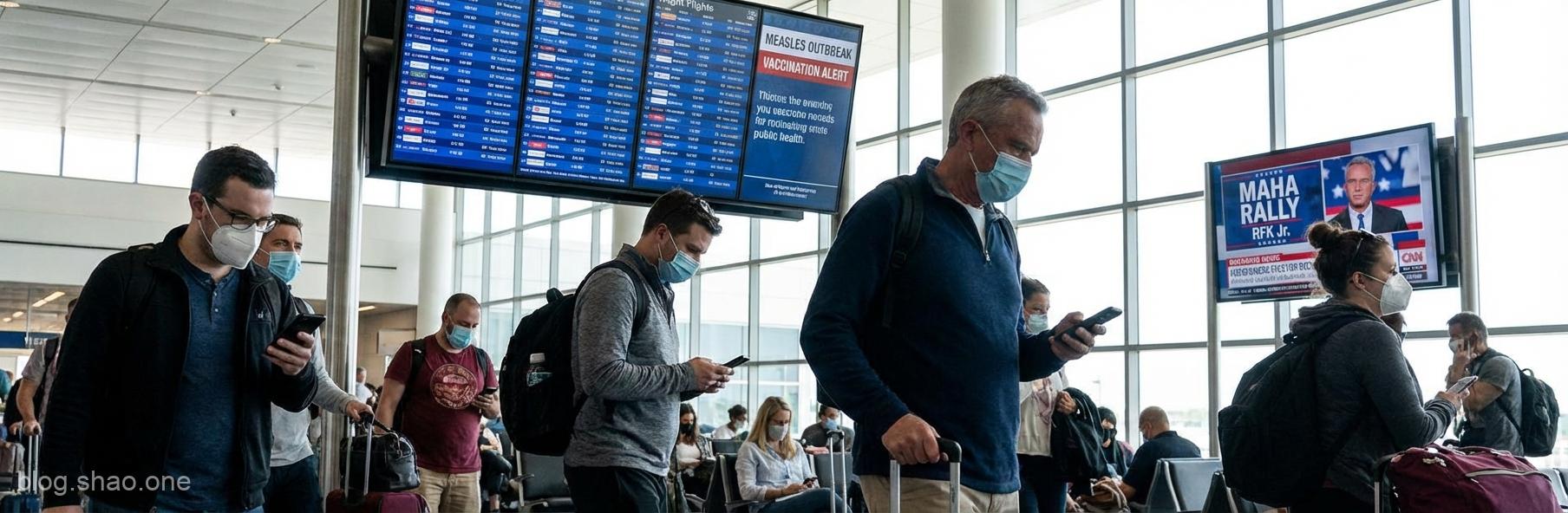
As 2025 approaches, we had anticipated more advanced medical AI or more precise wearable devices, but reality has instead delivered a chaotic start.Recently, the public health storm triggered by the U.S. "Make America Healthy Again" (MAHA) movement has plunged major airports like New Jersey into the threat of a measles outbreak. This is not merely a public health story; it's a product of the interplay between technology, data, and misinformation. As technology observers, we must ask: In an era of highly advanced information dissemination, why are we paradoxically "living like we're going backward"?
Incident Recap: A Scary Experience at the Airport During the Holidays
According to a report by The Daily Beast, the New Jersey Department of Public Health (NJDPH) and multiple healthcare institutions issued an urgent warning regarding multiple confirmed measles cases that emerged at major U.S. airports in early 2025. Below are the key points of this incident:
- Outbreak Point: The confirmed case had frequented a busy airport during the New Year's Eve period, coinciding with the peak season for travel technology.
- The Role of the MAHA Movement: Led by Robert F. Kennedy Jr., the MAHA movement centers its core demand on "health." However, its questioning of traditional vaccine science has been criticized as "bait-and-switch," effectively undermining the foundation of herd immunity.
- Impacted Areas: Beyond New Jersey, the pandemic shows signs of spreading to neighboring states, catching the public health system off guard.
Expert Commentary: How Can Science Communication Become a Catalyst?
This incident reveals profound technological concerns. We are living in an era of "information explosion," yet this double-edged sword has rendered scientific truths "unclear."
- The Algorithmic Echo Chamber Effect: Social media algorithms tend to push content aligned with users' interests. When anti-science sentiment ferments within specific groups, algorithms often "fan the flames," causing misinformation about public health to spread like a virus. This phenomenon is precisely what is known as "three people make a tiger."
- Lack of Data Transparency: Despite possessing robust data tracking technology, scientific evidence often falls short against emotional slogans when confronted with orchestrated "health campaigns." The MAHA movement leverages digital platforms for political mobilization while disregarding public health data warnings—a clear case of "working in isolation."
- The Trust Crisis in Health Technology: When the public begins to doubt the traditional healthcare system, even the most precise monitoring technology struggles to function effectively. If citizens refuse to share critical health data, the digital epidemic prevention network will develop significant gaps, leading to losses that cannot be recovered even with remedial measures.
In-Depth Analysis: Why Does the MAHA Movement Have the Scientific Community "Sitting on the Edge of Their Seats"?
The MAHA movement champions a return to nature and health, yet its methods run counter to modern science. In the tech world, we prioritize evidence-based approaches, whereas this movement carries strong populist overtones.
- The Tug-of-War Between Science and Pseudoscience: When scientists attempt to explain vaccine efficacy with complex charts, opponents need only one inflammatory meme to undermine public trust. This reveals how scientific facts often stand alone in the information war.
- Limitations of Airport Epidemic Prevention Technology: Although modern airports are equipped with infrared temperature screening and digital check-in systems, measles possesses a highly prolonged incubation period. Without the protective barrier of high vaccination coverage, even the most advanced sensing technology proves to be a drop in the bucket.
Future Outlook: The Digital Health Frontline in 2025
This incident serves as a wake-up call for the global technology community. We cannot merely pursue hardware upgrades; we must also strengthen the digital integration of "information literacy" and "public health governance."
- Combating Digital Misinformation: Tech giants must take more proactive measures to prevent anti-science content from misleading the public during critical moments. They cannot always wait until after incidents occur to "quell the situation."
- Enhance Digital Tracking and Early Warning: Leverage blockchain or privacy-preserving technologies to establish a more transparent and trusted disease tracking system, ensuring that outbreaks can be nipped in the bud at their earliest stages.
- Redefining Science Communication: The scientific community must learn to engage the public in more relatable ways by leveraging new media technologies, preventing pseudoscience from dominating the discourse.
Conclusion: Don't let progress become a step backward.
2025 was supposed to be a year of technological leaps for humanity, but this airport measles storm reminds us: without respect for science and honesty with data, even the most advanced technology cannot guarantee our safety. Facing the challenges brought by the MAHA movement, what we need is the courage to "see through the fog" and re-examine the relationship between technology and human well-being.May this pandemic teach us to learn from our mistakes and never again let the price of ignorance be paid with the health of the entire population.”