“
Introduction: Transcending the Boundaries of the Five Senses
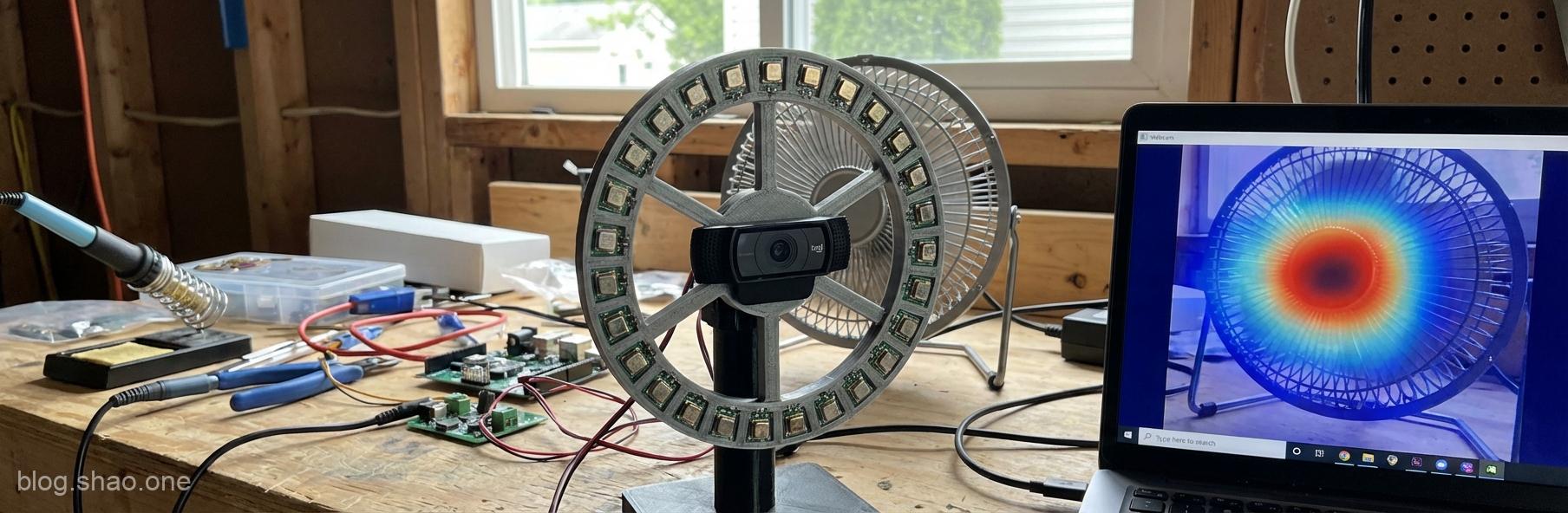
As the saying goes, "seeing is believing." We're accustomed to observing the world with our eyes and listening to sounds with our ears. Yet in the tech world, there's always a group of people who aren't satisfied with this. They insist on "thinking outside the box," devising ways to "materialize" those invisible, intangible waves.Recently on the renowned DIY platform Hackaday, a master named Plasmatron shared an astonishing project: he successfully built an acoustic camera for under $200 (approximately NT$6,000).The news left many engineers and makers utterly astonished, as similar industrial equipment typically costs tens of thousands of dollars—far beyond the reach of ordinary people. Today, we'll explore how this technology makes sound "visible" and the significant implications it represents.
Core Technology: How to Make Sound "Visible"?
The core logic of this device is actually quite straightforward, but its implementation requires considerable effort. Simply put, it utilizes microphone array technology—essentially giving the machine dozens of ears. Through sophisticated algorithms, it calculates the time difference in sound arrival at each microphone, enabling precise localization of the sound source.The following are the technical highlights of this project:
- MEMS Microphone Array: Utilizing low-cost yet highly sensitive microelectromechanical microphones arranged in specific geometric patterns to capture minute acoustic variations.
- Real-time Signal Processing: Through powerful computation, converts received sound pressure data into a "heatmap."
- Image Overlay: Directly superimposes the generated sound source heatmap onto the video footage captured by the camera lens. When you see a "red" area in the image, it indicates that sound is emanating from that location.
This technology was once considered "black tech," typically found only in aircraft engine diagnostics, submarine tracking, or expensive factory leak detection equipment. Now, Plasmatron delivers it at an affordable price—truly eye-opening.
Why is this important? (Commentary and Analysis)
The fact that this project has sparked heated discussions within the tech community is no coincidence. Its significance lies not only in cost savings but also in its concrete embodiment of "technological democratization."
1. Lower the technical barriers to enable creativity to flourish everywhere.
In the past, such expensive instruments were the exclusive domain of academic institutions or large corporations. Now, ordinary students, amateur makers, and even small repair shops can afford an acoustic camera at an accessible price. As these tools become more widespread, we'll see more down-to-earth applications emerge.For instance: pinpointing the source of abnormal noises in an aging motorcycle, identifying which fan is causing trouble inside a computer case, or even locating subtle leaks within home walls.
2. Ultimate Value for Money
In Taiwan, we place great emphasis on value for money. Plasmatron doesn't rely on expensive custom parts; instead, through clever design and open-source software, it manages to slash costs to just one percent of industrial-grade products. This ability to "turn stones into gold" lies at the heart of the maker spirit—not blindly following brand-name equipment, but solving problems with ingenuity.
3. Seamless Integration Across Disciplines
This project integrates acoustics, electronic engineering, computer vision, and digital signal processing (DSP). It reminds us that in modern technological development, "cross-disciplinary collaboration" has become the norm. If you only master one field, it's difficult to create such an astonishing work.
Expert Perspective: Insights from the Maker Community
As a technology observer, I believe the greatest insight this project offers is: "Don't let price limit your imagination." Often, we perceive a technology as distant because its commercial price seems prohibitively high. But with a spirit of exploration, delving into open-source community resources might just reveal a way to "hack" your way around it.This device, priced under $200, may not match the precision of professional instruments costing millions, but it's more than sufficient for 90% of everyday applications. It proves that with a little ingenuity, even scrap metal can be transformed into a powerful tool.
Closing remarks: The next technological breakthrough is right in your garage.
Watching the sound dance across the screen, this marvelous interplay of sight and sound is precisely what makes technology so captivating. The Plasmatron project is not merely about creating a tool; it is a declaration to the world that the value of creativity cannot be measured in monetary terms.If you're also a hands-on enthusiast, doesn't this make your fingers itch to get started? Perhaps the next world-changing low-cost tech will emerge right from your desk. Stop waiting—dig out your microphone and begin your journey to "see sound"!
【Further Reflection】If you had an acoustic camera, what sound would you most want to "see"? Is it the mysterious footsteps from your neighbor in the dead of night, or the whining of your ancient computer? Share your thoughts in the comments below!”