“
Foreword: Seeing isn't always believing—spaces may not be what you expect.
In daily life, when we stand on a plain and gaze into the distance, the earth appears as an endless flat surface.This sensation intuitively leads us to accept Euclidean geometry—the very theory we learned in middle and high school that "the shortest distance between two points is a straight line." Yet, as the old saying goes, "a frog at the bottom of a well" cannot grasp the full expanse of the ocean. When we broaden our perspective to encompass the entire planet, or even the entire universe, this flat-world principle begins to show its limitations.Today's central topic is the concept of "manifolds" proposed by 19th-century mathematical genius Bernhard Riemann. This idea was not only a groundbreaking innovation in its time but also became the cornerstone of modern geometry and general relativity. Let's explore how this mathematician used a single concept to revolutionize humanity's understanding of space.
Core Story: From "Local Flatness" to "Global Curvature"
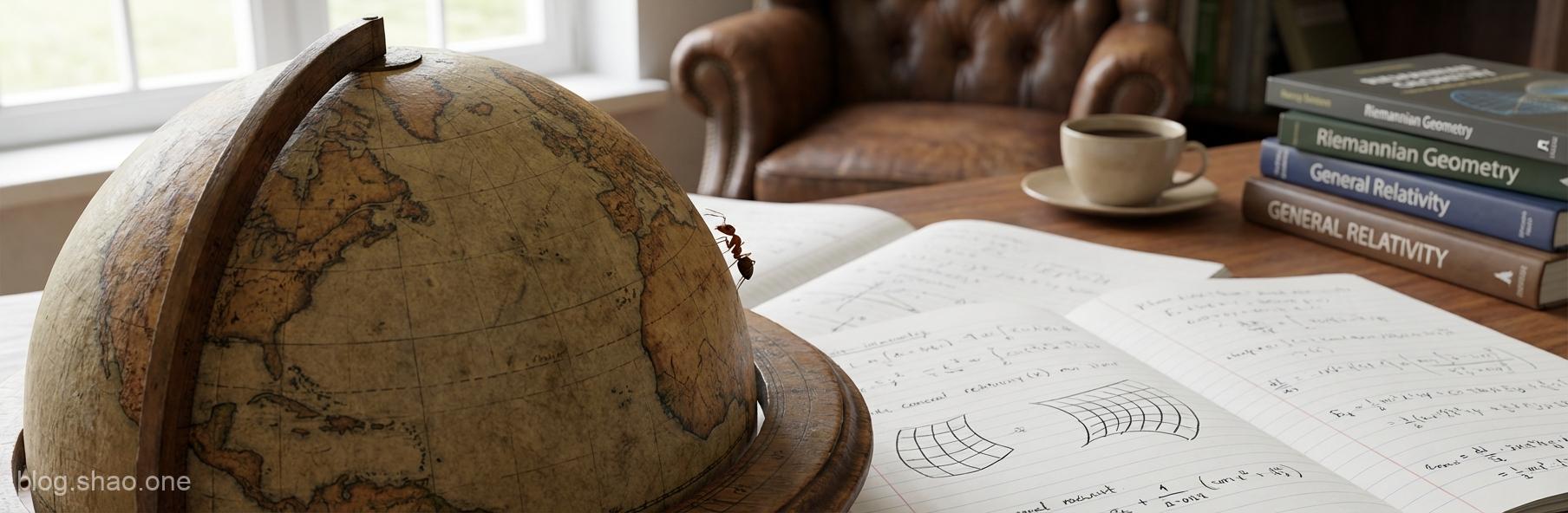
WIRED magazine recently revisited this historical period.Before Riemann, most people envisioned geometry confined to flat spaces. But Riemann proposed a remarkably "down-to-earth" idea: even if an object's overall shape is extremely complex—like the bumpy surface of an orange peel or a twisted doughnut—if we zoom in to a sufficiently minute local area, it will appear flat.This is the core definition of a "manifold":* Local flatness: Imagine you are an ant crawling on a giant sphere. The world around you appears flat. This structure—where the local region seems flat yet the overall shape is vastly different—is what defines a manifold.* Extension of Dimensions: Riemann was not satisfied with three-dimensional space; he extended this concept to "n-dimensional" space. This implies that space is not limited to length, width, and height, but can encompass an infinite number of dimensions existing simultaneously.* Metric Tensor: He introduced a method for measuring distances in curved spaces, freeing mathematicians from the constraints of rigid coordinate systems.
Profound Impact: Einstein's "Secret Weapon"
When Riemann introduced the concept of manifolds, many dismissed it as a purely mathematical "castle in the air"—elegant yet impractical. Little did they know that decades later, as Einstein grappled with formulating general relativity and struggled to describe spacetime warped by gravity, he discovered that Riemannian geometry was a tool tailor-made for his needs.
- Space-time is a manifold: In modern physics, the universe we inhabit is viewed as a four-dimensional manifold. Gravity is no longer an invisible "force," but rather the curvature of the manifold itself.
- Milestones in Science: Without the concept of manifolds, the birth of general relativity might have been significantly delayed. This stands as the prime example of mathematics advancing ahead of physics, ultimately leading to a natural and inevitable outcome.
Expert Commentary: Why Should We Still Care About Manifolds Today?
You might be thinking: "This sounds pretty abstract, but what does it have to do with me?" In fact, the concept of manifolds still plays a pivotal role in today's tech world:
- Big Data and Machine Learning: When processing high-dimensional data—such as thousands of facial photographs—modern AI typically assumes these data points lie on a low-dimensional "manifold." This concept, known as "manifold learning," forms the core of dimensionality reduction techniques, enabling computers to more intelligently recognize faces or predict trends.
- Cosmic Exploration: Whether studying black holes or cosmic expansion models, we must rely on the mathematical framework of manifolds. Without it, our imagination of the vast cosmos would remain at the stage of "a blind man feeling an elephant."
- GPS Positioning: Since the Earth is a manifold (a curved surface approximating a sphere), satellite positioning must account for curvature corrections. Otherwise, errors could lead to "a slight miscalculation resulting in a significant deviation."
Conclusion: Mathematics is the ultimate language for understanding the universe.
Riemann's story teaches us that breakthroughs in fundamental science often arise from challenging everyday intuition. He showed us that though humans are small, through the logical reasoning of our minds, we can construct frameworks that transcend sensory limits to comprehend the entire starry sky.The birth of the manifold concept was not merely a mathematical advancement but a revolution in thought. It shattered existing paradigms, proving that "space" itself is an entity that can be curved, computed, and even reshaped. In today's era of rapidly advancing technology, revisiting this history still evokes that profound sense of revelation—like seeing the sun emerge from behind the clouds.”