“
Foreword: Storm clouds gather over the tower, as the healthcare system faces yet another severe challenge.
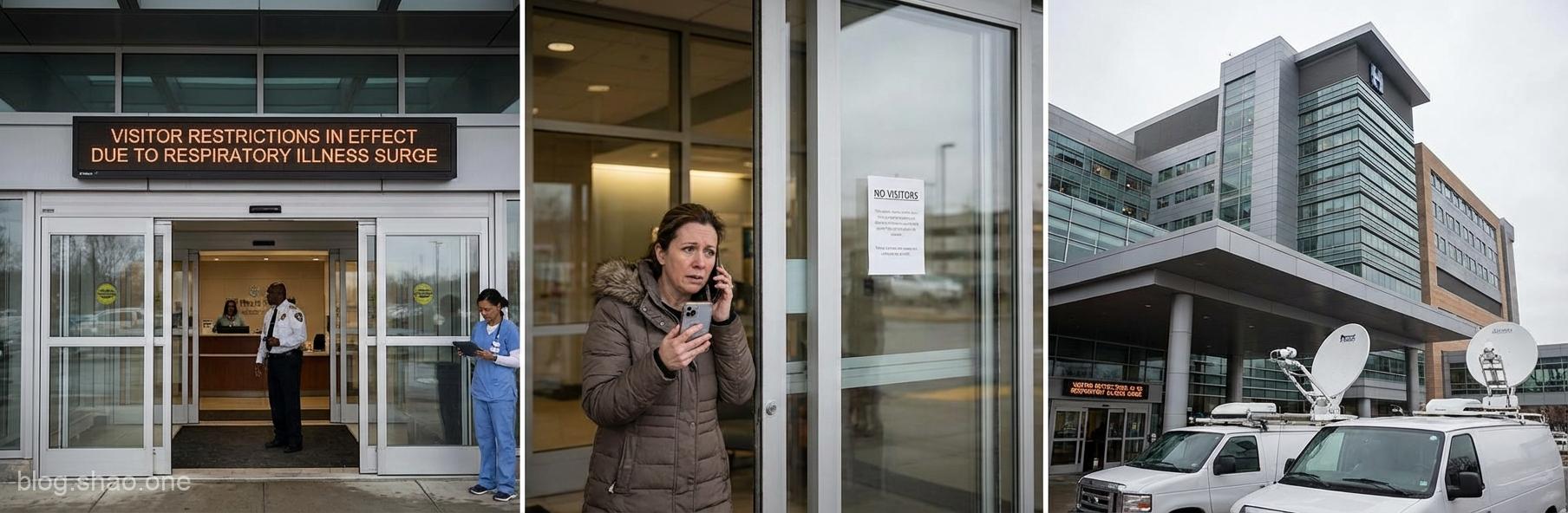
Hello, tech enthusiasts and friends interested in health trends.A recent international news story has sent shockwaves through both the medical and tech communities. In Miami Valley, Ohio, a sudden surge in respiratory illnesses—including influenza, COVID-19, and RSV—has forced 29 local hospitals and healthcare systems to implement extraordinary measures: temporary visitor restrictions.For us, who were gradually entering the "post-pandemic era," this serves as a wake-up call: "Better late than never." Yet in the face of disease, prevention and technological intervention are truly "urgent and unavoidable."
Breaking News: 29 Medical Institutions Close Their Doors to Patients
According to WHIO TV, this restriction is not unfounded but a direct response to the recent surge in respiratory infections.To protect hospitalized patients and frontline medical staff, these 29 hospitals have had to implement restrictions to prevent cross-infection within their facilities. While this may feel like a harsh blow to many family members hoping to visit their loved ones, it is a necessary evil—choosing the lesser of two evils—when considering public health.
Tech Watch: When Physical Doors Close, How Do Digital Windows Open?
As technology observers, we cannot merely focus on the conveniences brought by medical restrictions; we must also explore how technology can provide more flexible solutions during such "dilemmas." Below is our in-depth technology commentary and future trend analysis on this event:
- The New Chapter of Telemedicine's Veteran:
- AI Predictive Models: Preparing for the Future
- Intelligent Monitoring and IoT: "Leaving No Detail Unattended"
With visitor restrictions in place, telemedicine is no longer a mere "icing on the cake" but a "lifeline in times of need." Through high-definition video and stable 5G transmission, family members who cannot be physically present can still communicate with patients via tablets or smart devices—a crucial source of psychological support for patients.As the saying goes, "Though miles apart, we're as close as neighbors." Technology is bridging the gaps created by physical distance.
Why were these 29 hospitals able to make swift decisions? Behind the scenes, powerful big data and AI algorithms provided crucial support. By monitoring regional outpatient traffic, wastewater testing data, and keyword search trends, the healthcare system could accurately predict outbreak periods. This enabled preemptive action before the epidemic could spread like wildfire, implementing restrictions to preserve medical capacity.
In scenarios where staffing is tight and contact must be minimized, the value of smart wards becomes evident. IoT sensors can transmit patients' blood oxygen levels, body temperature, and respiratory rate in real time. Should any abnormalities arise, the system automatically triggers alerts, enabling medical staff to "treat the root cause" while reducing unnecessary frequent visits and lowering infection risks.
Author's Commentary: Technology ultimately stems from a concern for humanity.
The restrictions implemented by Miami Valley Hospital may appear superficially as defensive measures within healthcare administration, but at a deeper level, they represent a crucial opportunity for the transformation toward smart healthcare. While many worry that technological intervention might strip healthcare of its "human touch," I believe that when pathogens threaten lives, the precision and efficiency technology provides are the most tangible expressions of compassion.We often say, "Water from afar cannot extinguish a nearby fire." In the past, once a ward was sealed off, family members could only wait anxiously outside. But now, through virtual reality (VR) visits or smart communication systems, even with ward doors tightly shut, care can still "break through" to reach patients.In this protracted battle against respiratory viruses, we cannot rely solely on traditional social isolation; we must also depend on the continuous innovation of technology.
Conclusion: Stay vigilant in times of peace; technological epidemic prevention is a long-term battle.
In summary, the incident in Miami Valley serves as a microcosm of the shifting global healthcare landscape. Faced with an ever-evolving virus, we must maintain a vigilant mindset. Technological advancement should not merely pursue speed; rather, it must become a steadfast bulwark safeguarding human health in critical moments.The visitor restrictions at hospitals are temporary, but the healthcare transformation brought by technology is profound. It is hoped that these 29 hospitals will leverage this experience to further optimize their digital services, enabling the healthcare system to respond with greater agility to future challenges and achieve true flawlessness.Views from Science and Technology Special Envoys:In the future, we may see greater standardization of "virtual hospital visits." This isn't just about responding to pandemics—it's about enabling loved ones who are far away and "out of reach" to offer the most timely embrace during their family members' most vulnerable moments. This is where technology's true value lies.”