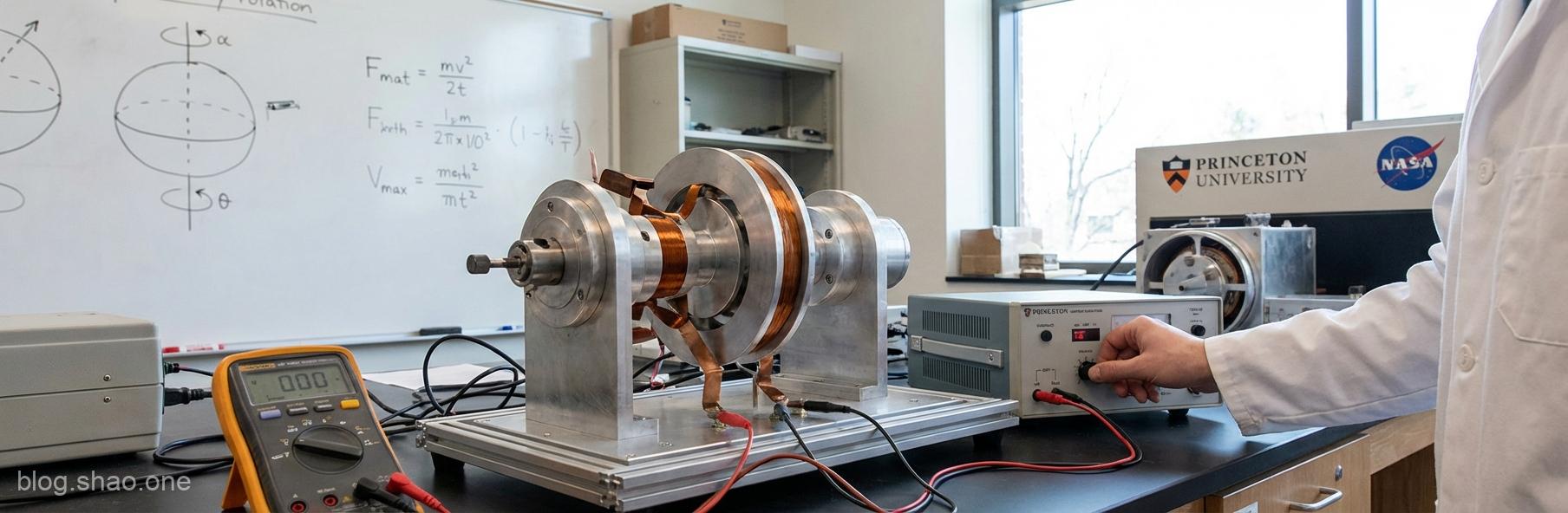
“Tech enthusiasts, have you ever wondered what else our round, spinning planet can do besides giving us day and night and beautiful sunsets? If you think Earth's rotation is just a natural phenomenon, you're underestimating human ingenuity!Recently, NASA and scientists from Princeton University truly thought outside the box. They've successfully developed a device that can actually extract electricity directly from the Earth's rotation. That's right—in the future, we might not just rely on the sky for sustenance, but on the "globe" itself!
🔬 A Tiny Breakthrough in the Lab: Harnessing Electricity from Rotation
This research may sound like something straight out of a sci-fi movie, but scientists are dead serious about it. The team set up a sophisticated experimental apparatus on a tabletop and successfully demonstrated how to convert the kinetic energy generated by Earth's rotation into electricity. While the current results are still in the very early stages, this breakthrough has already sent shockwaves through the scientific community.Here are several key highlights of this experiment:* Tiny Device, Huge Potential: Researchers have developed a small, desktop-sized device. Although it currently generates only a few dozen microvolts—far too little to light a single bulb—it proves this physical mechanism is genuinely feasible.* NASA and Princeton Team Up: This development team is no pushover, combining cutting-edge aerospace technology with fundamental physics to seek a more stable "sustainable energy" source beyond solar and wind power.* Ingenious Application of Physics: This device harnesses the angular momentum generated by Earth's rotation and the principle of electromagnetic induction. Simply put, it treats the Earth as a massive generator rotor, while our device functions as the stator.
💡 Why is this such a big deal? (Editor's Note)
Many might scoff, "Just a few microvolts? The static electricity I generate rubbing a plastic ruler with my hands is stronger than that!" But hold your horses, folks—the significance here lies in the "stability of the energy source."1. Completely break free from the predicament of being at the mercy of the weatherThe biggest drawback of traditional green energy sources like solar and wind power is their instability. Clouds come, no power; wind stops, no output—it's like "relying on mountains, they collapse; relying on rivers, they flow away."But Earth's rotation never stops for 24 hours (unless the apocalyptic Hollywood movie scenario actually unfolds). This means that if this technology can be scaled up, we will possess a truly "round-the-clock" baseload energy source.2. New Pathways for Space ExplorationIf this works on Earth, what about other rotating planets? For NASA, if this technology can be applied to future missions on Mars or other planets, scientists won't have to worry about dust storms blocking solar panels or power running out during the long planetary nights. It's essentially a "super power bank" for space travel!
🚧 Every journey begins with a single step: Future challenges and real-world tests
While this technology is truly exciting, we must be honest: it's still too early to talk about "Earth-rotation power plants." There are numerous challenges to overcome at present:
- Energy density is too low: Compared to current commercial electricity, power in the tens of microvolts is like comparing a minor wizard to a grand sorcerer. How to improve energy conversion efficiency will be the most challenging problem for scientists moving forward.
- Materials and Scalability: To construct a device capable of capturing sufficient kinetic energy, its material strength and structural design must be extremely precise. Otherwise, the device may be destroyed by vibrations before it even generates electricity.
- Cost Considerations: The greatest fear in technological R&D is developing solutions in isolation. If the future cost of generating a single kilowatt-hour of electricity becomes more expensive than gold, then this technology will inevitably be consigned to the museum's storage room.
🌟 Conclusion: A towering edifice rises from the ground up; science is nothing but a continuous process of trial and error.
This research, brought to us by NASA and Princeton University, may seem rudimentary at present, but it opens a new window onto humanity's energy crisis. Scientific progress often begins with seemingly "useless" small experiments. When Faraday discovered electromagnetic induction, someone asked him, "What use is this?" He replied, "What use is a newborn baby?"In this era of frequent extreme weather and the urgent need for energy transition, we need more of these groundbreaking ideas. While large-scale implementation remains a long way off, scientists have at least taken the first step for us. Let's wait and see if we can truly illuminate every light in the world through the Earth's rotation!Do you think this "Earth Power Generation Method" is credible? Or do you think it's just another "fairy tale" from scientists? Feel free to share your thoughts in the comments below!“