“
☢️ Foreword: A Miracle Blooming in the Face of Despair
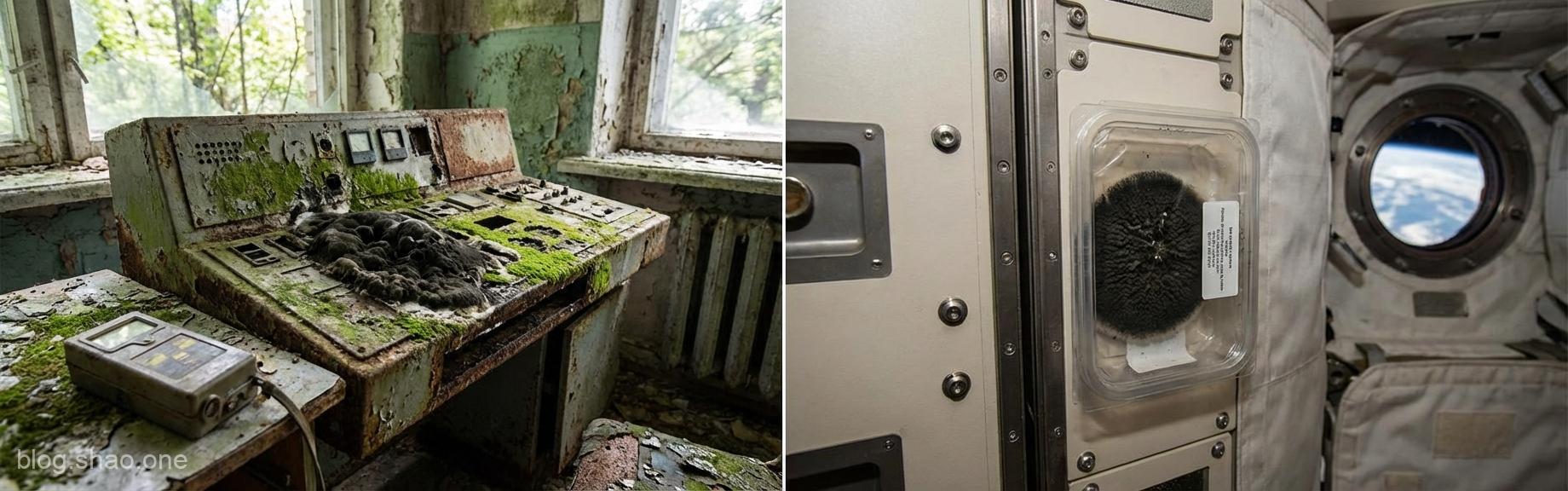
The 1986 Chernobyl nuclear disaster was a nightmare in human history, where radioactive leaks turned the surrounding area into a barren "exclusion zone" devoid of life. Yet nature always manages to stage its own "alchemy of decay."Scientists discovered a mysterious black fungus—Cladosporium sphaerospermum—thriving within the deadly radiation of the reactor ruins. Far from being killed by radiation, this fungus not only survived but flourished.This discovery has recently sent shockwaves through the scientific and aerospace communities, as these "nucleophiles" have now been sent to the International Space Station (ISS) for experimentation. This represents not only a breakthrough in biology, but also a crucial dawn for humanity's future colonization of Mars and conquest of the vast cosmos.
🧬 Core Mechanism: Radiative Synthesis—Turning Stone into Gold
Why does this fungus treat radiation like a nutritional supplement? This is due to the large amount of melanin within its body. While similar in function to the melanin found in human skin, its capabilities are far more potent.
- Radiation Conversion Energy: This fungus possesses a capability known as "radiosynthesis." It absorbs high-energy ionizing radiation and converts it into biochemical energy via melanin, thereby enabling its growth and metabolism.
- Self-repair: Under extreme conditions, it rapidly repairs damaged DNA, demonstrating the tenacious vitality of a creature that remains resilient even in the face of death.
【Curator's Commentary】: We've always regarded radiation as both a byproduct and a poison of technological progress, but this fungus reveals that waste is merely a resource in the wrong place. This evolutionary adaptation—a product of natural selection—is nothing short of nature's ultimate black technology.
🚀 Space Experiment: Protective Shields on the ISS
To address the cosmic radiation challenges faced by astronauts, scientists sent Aspergillus oryzae to the International Space Station. The experimental results revealed that this fungus's performance was remarkably impressive:
- Natural Barrier: Experiments reveal that a fungal layer just 1.7 millimeters thick can block approximately 2% of cosmic radiation. If the layer were thickened to 21 centimeters, it could theoretically completely offset the annual radiation dose astronauts endure during Mars missions.
- Autonomous Regeneration: Unlike traditional lead plates or water tanks, fungi are "living." Given minimal nutrients (even utilizing astronaut waste), they can self-repair through growth. This capability is an absolute game-changer for deep-space missions where resources are scarce.
【Curator's Commentary】: Imagine the outer shell of a future Mars base not made of cold metal, but a thick layer of black bio-membrane. This not only reduces the cost of transporting bulky protective equipment from Earth but also embodies the space-age vision of "local sourcing and circular economy."
💡 Future Applications: Not Just for Space, But Earth's Savior
The discovery and research of this fungus hold significant implications for the technology industry:
- Space Migration Supply Station: For future Mars voyages lasting several months, biological shields will become standard equipment, ensuring astronauts do not suffer health breakdowns from radiation exposure before reaching their destination.
- New Approach to Nuclear Waste Disposal: This fungus may be applied in nuclear power plant waste disposal sites to accelerate the degradation or encapsulation of radioactive contamination.
- Biological shielding material: Develop novel wearable devices based on melanin to protect medical personnel or technicians working in high-radiation environments.
📝 Conclusion: Only by preparing for the future can we move steadily and far.
As the saying goes, "Every crisis is an opportunity." The painful lessons from the Chernobyl nuclear disaster ultimately paved the way for humanity's journey into space decades later. Although the radiation-reducing efficiency of Bacillus subtilis still requires optimization through genetic engineering, this step has already been taken with decisive strides.Facing the unknown of outer space, we cannot always rely on hard armor to clash head-on.Sometimes, the softest, most diminutive life forms possess the power to "overcome hardness with softness." The evolutionary journey of this "radiation-eating" fungus serves as the ultimate commentary on humanity's technological quest to explore nature and achieve self-redemption. We should approach this with humility, continuing to observe how these "dark knights" lead us across the chasm of radiation, paving the way for the true realization of interstellar colonization.Do you think biological shields will become the mainstream for future space travel? Share your thoughts in the comments section!“