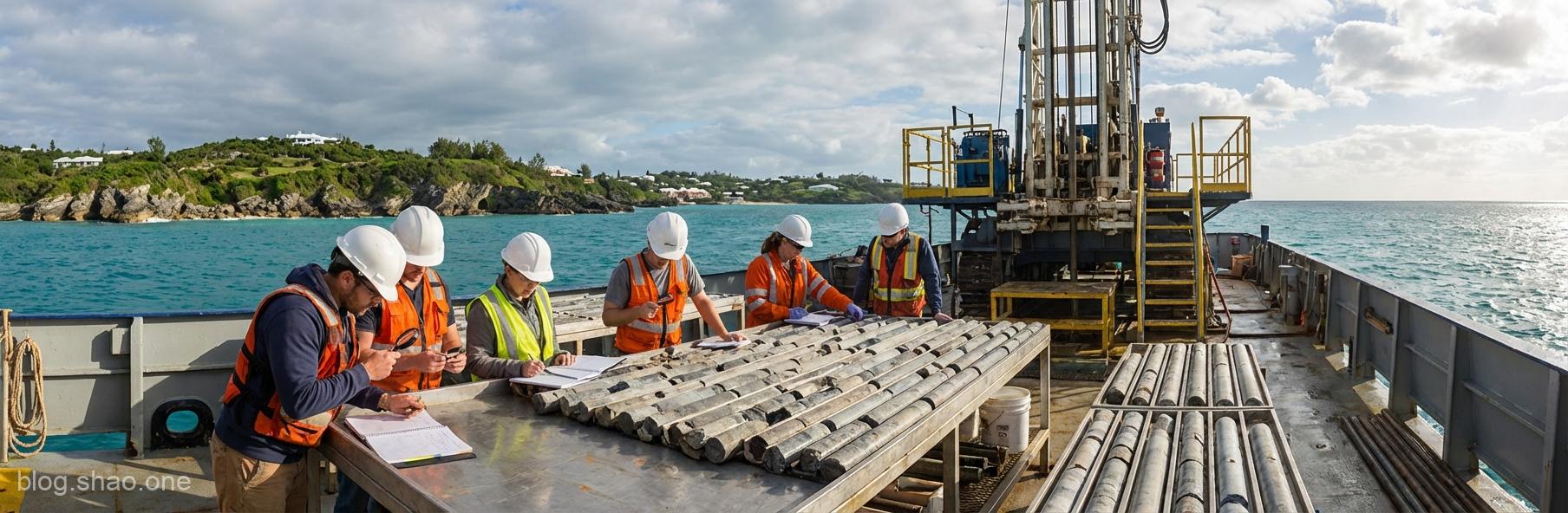
“When it comes to "Bermuda," most people likely picture mysterious ship and plane disappearances or various supernatural legends. But for geologists, the region's true mystery lies not in these tales, but in the "unconventional" geological strata beneath their feet.Recently, a study published in Nature magazine finally lifted the veil of mystery shrouding the Bermuda Islands' subterranean landscape—a discovery that has truly opened the eyes of the scientific community.
At a complete loss: Bermuda's geographical paradox
For a long time, the formation of Bermuda has baffled geologists. Generally speaking, volcanic islands form through one of two mechanisms: either by a stable mantle plume beneath them, as seen in Hawaii, or through tectonic plate movements, as observed at the Mid-Atlantic Ridge.Yet Bermuda defies both categories. It appears as an uninvited guest, quietly resting at the center of the Atlantic basin, its geological features completely at odds with its surroundings.Scientists decided to "get to the bottom of it" by conducting chemical analyses on core samples drilled deep within Bermuda, seeking clues to its origins. This research, led by a Cornell University team, successfully uncovered crucial evidence in the Mantle Transition Zone—located approximately 410 to 660 kilometers below the Earth's surface.
Core Discovery: "Secret Tunnels" Deep Beneath the Earth
The research team discovered that the magma beneath Bermuda does not originate from the shallow mantle, but rather from a deep region rich in water, crystals, and lava. Below are the key findings of this study:
- A novel volcanic mechanism: For the first time, scientists have confirmed that materials in the Earth's mantle transition zone can be stirred up by tectonic plate movements, eventually forming volcanoes. This discovery is vastly different from what we learned in textbooks.
- Chemical fingerprint: The sample exhibits significant amounts of lead isotopes and volatile substances (such as water), indicating that this magma chamber harbors remnants of ancient crustal material thrust underground hundreds of millions of years ago.
- A product of time and space intertwining: Approximately thirty million years ago, fragments of the crust left behind when Pangaea fractured lay dormant deep within the earth for eons. Stirred by some disturbance, they reignited, rising upward to form the Bermuda Triangle.
Author's Commentary: Why is this discovery "no small matter"?
The significance of this research extends far beyond simply "discovering another volcano." In today's rapidly advancing technological landscape, our understanding of Mars' surface may even surpass our knowledge of Earth's internal structure. The Bermuda example reveals that Earth's interior is far more dynamic than previously imagined, with chemical flows deep within the mantle proving far more complex than current theoretical models suggest.In the past, we believed volcanoes had only a few rigid causes, but Bermuda's structure is truly one-of-a-kind. It demonstrates that the mantle transition zone functions like a massive "geothermal recycling station," capable of generating new geological wonders in unexpected places at any moment. This not only challenges existing geological models but also offers a fresh perspective for studying planetary evolution.
Conclusion: The tip of the iceberg
Though the legend of Bermuda's mysterious vanishing may be mere nonsense, the scientific truths beneath its surface are more astonishing than any science fiction. These research findings represent merely the tip of the iceberg. Scientists anticipate that similar geological structures may exist in other regions around the globe, yet remain undiscovered. For those passionate about technology and science, this serves as a stark reminder: nature always has something up its sleeve, waiting for us to uncover.This geological "shocking education" has only just begun. Let's wait and see what earth-shattering discoveries future scientists will unearth from our mysterious planet!”