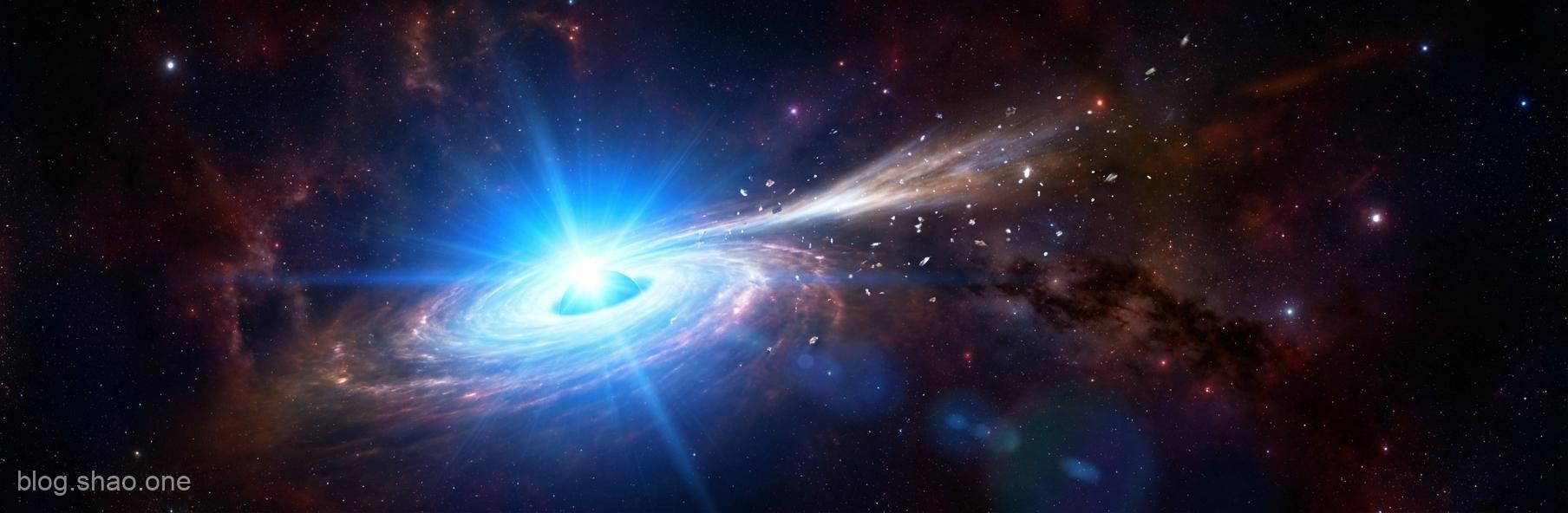
“Good morning, fellow tech and astronomy enthusiasts! Today I'm sharing some mind-blowing cosmic news that will truly open your eyes. If you thought stellar explosions (supernovae) in the universe were already mind-boggling, this latest discovery in astronomy will make everything you've seen before seem like child's play.Scientists recently observed a mysterious "blue fireball" whose energy was so intense it was "no joke." After in-depth research, astronomers finally uncovered the truth: this wasn't just some ordinary stellar explosion, but the universe's ultimate "glutton"—a black hole—vigorously "tearing apart" a star!
What are "mysterious blue light bullets" (LFBOTs)?
This mysterious phenomenon is known in scientific circles as a "Fast Blue Optical Transient" (LFBOT). Put simply, it's like a cosmic flashbang grenade—not only blindingly bright, but vanishing at an astonishing speed. The signal detected this time ranks as the "brightest" of its kind, so intense that even seasoned astronomers exclaimed, "What the hell is that?"According to a report by Space.com, the energy unleashed by this eruption was astonishingly immense. Researchers stated: "The radiation energy was so massive that you simply cannot explain it with any 'core-collapse supernova' scenario." In other words, ordinary stellar explosions simply couldn't handle the task—they lack the capacity to produce such terrifying energy output.
Crime Scene: Black Hole Shattering Stars
Why are scientists so confident this wasn't an ordinary explosion? The key lies in the source of the energy. This signal reveals that at the heart of this cosmic spectacle was actually an unlucky star that accidentally wandered into a black hole's territory, only to be torn apart by the black hole's immense gravitational pull. This process is known in astronomy as a Tidal Disruption Event (TDE).
- Black holes don't just devour—they also "tear": When stars approach a black hole, the immense gravitational pull stretches them like ramen noodles before completely shredding them.
- The Truth About Blue Light: Before plunging into a black hole, these shredded stellar fragments generate extreme heat through intense friction and collisions, emitting this dazzling "mysterious blue light."
- This is no ordinary evolution: We once thought LFBOTs were merely a special type of supernova, but now it appears black holes are simply "adding to the feast."
Tech Brief: Why Is This Discovery "Highly Significant"?
The discovery has sparked collective excitement among scientists worldwide for the following reasons:
- Challenging conventional wisdom: Our past understanding of cosmic energy explosions largely centered on "stars reaching the end of their lives." This discovery proves that black hole activity is far more "diverse" (and violent) than we ever imagined.
- Leaps in Observation Technology: The ability to capture such fleeting yet intense signals means modern astronomical equipment is now precise enough to detect a man sneaking a midnight snack in his room—just kidding, it's precise enough to catch a momentary flash at the edge of the universe.
- Solving a Decade-Old Mystery: LFBOTs have long been an enigma since their discovery, with no one able to pinpoint their true nature. This research finally provides them with an official identity.
Author's Perspective: Does the Universe Play "Musical Chairs"?
After reading this news, I couldn't help but marvel at how truly "nothing is impossible" in the universe. Black holes—these seemingly motionless monsters that only swallow light—can actually cause such a tremendous stir when they move. This serves as yet another reminder that despite humanity's belief in our technological prowess, we still have a lot of "work" to do in the face of the vast cosmos.This discovery does more than solve a scientific puzzle; it offers a down-to-earth reminder that energy transformations in the cosmos are far more radical than what we learn in physics textbooks. The blue light emitted by stars torn apart by black holes shines like cosmic neon lights, reminding us of the danger and beauty of this starry sky.To sum up: This major astronomical discovery proves that LFBOTs are absolutely not ordinary stellar explosions, but rather a "star-shattering spectacle" unleashed by black holes firing at full power. Now, scientists can finally stop puzzling over that blue light and instead begin studying more details of how black holes "feed"!What are your thoughts on the "violent beauty" of black holes? Share your insights in the comments below and let's explore these mind-blowing cosmic mysteries together!”