“
🌌 The Universe Theater Presents "Fatal Drive": The Hubble Telescope Becomes the Ultimate Dashcam
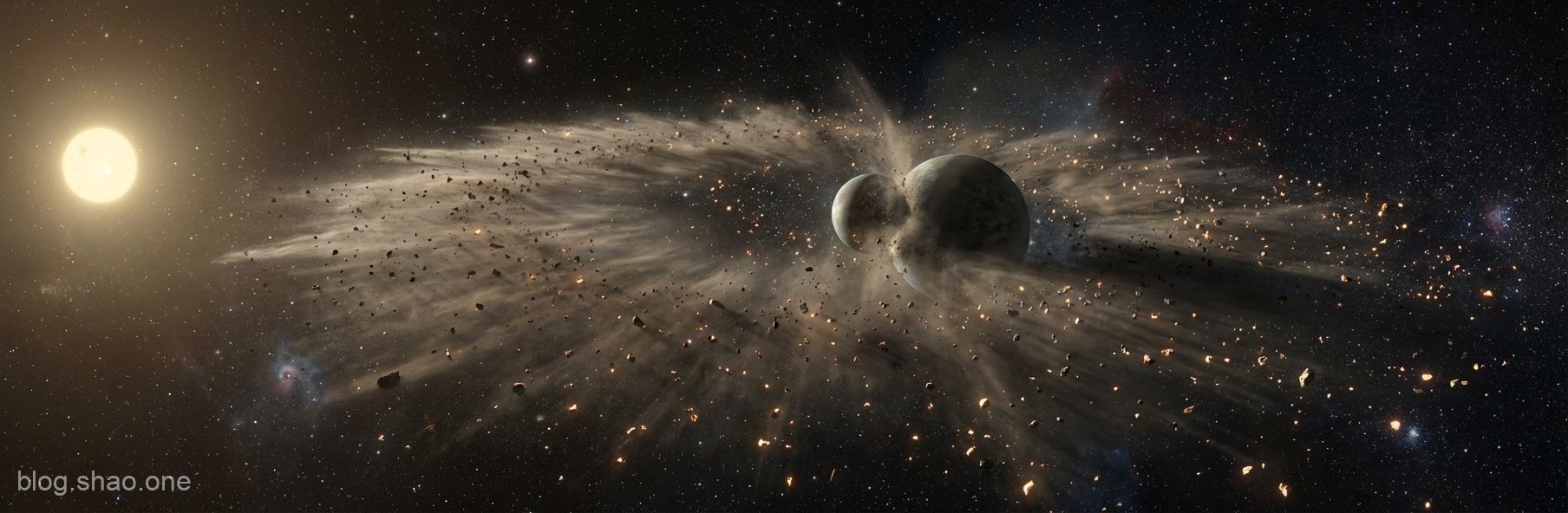
Tech enthusiasts and astronomy buffs, grab your seats—today we're not discussing the latest smartphone from tech giants, but a "cosmic-scale catastrophe" unfolding light-years away!According to the latest report from Phys.org, NASA's Hubble Space Telescope (HST) has once again demonstrated its enduring prowess, capturing the stunning aftermath of a head-on collision between two massive space rocks in a nearby planetary system. This "interstellar bumper car" event isn't just a visual spectacle—it's an invaluable treasure trove for scientists.To be honest, capturing such a fleeting collision in the vastness of the universe is harder than finding a needle in a haystack. But this time, Hubble got incredibly lucky, managing to catch this rare moment head-on. For scientists studying planetary evolution, this is a jaw-droppingly significant discovery!
📸 Major Discovery: This "Car Accident" Is No Ordinary Incident
This observed phenomenon occurred within a young stellar system. When astronomers initially targeted this region for routine inspection, they unexpectedly discovered an unusual dust cloud. This was no ordinary dust—it was evidence of a major event: two rocky bodies, each comparable in size to a large asteroid or protoplanet, collided at astonishing speeds, shattering each other intoshattered into pieces.Here are the key highlights of this observation:
- An unprecedented sighting: This marks humanity's first close-up observation of the violent collision debris within a planetary system.
- A Surge in Dust: The fine dust generated by collisions forms an exceptionally bright region when illuminated by starlight, resembling a scattering of fluorescent powder across the cosmos.
- Dynamic Evolution: Observations reveal that these debris clouds are rapidly dispersing, enabling scientists to observe the "chaos with order" physical process in real time.
💡 In-Depth Analysis: Why Should We Care About This "Disaster Scene" Millions of Light-Years Away?
You might be thinking, "This car accident happened so far away—what does it have to do with me?" Hold on—the science behind it is actually quite complex:
- The "Violent Aesthetics" of Planetary Birth: The Earth we now inhabit peacefully was actually forged billions of years ago through countless such head-on collisions. Observing these impacts is like viewing our planet's "ultrasound images," revealing that planetary formation was not a smooth process but one filled with collisions and destruction.
- Hubble's "Veteran Value": While everyone is now discussing the more advanced James Webb Space Telescope (JWST), Hubble's latest discovery proves it remains top-notch in the ultraviolet and visible light spectrums. In the astronomical community, Hubble is certainly no "outdated relic"—it's a seasoned veteran ready to surprise us at any moment.
- Clues to Atmospheres and the Origins of Life: Collisions of this magnitude release vast quantities of gases and minerals, which are crucial for understanding the formation of planetary atmospheres. After all, whether life can emerge often hinges on whether these post-collision chemical reactions are "pinpoint precise."
🚀 Conclusion: Seeking Answers in the Stardust Ocean
This rare collision captured by the Hubble Space Telescope serves as another reminder of the dynamic and untamed nature of our universe. It is not merely a spectacular visual spectacle, but also a crucial "puzzle piece" for scientists piecing together the map of cosmic evolution.For us ordinary people, this offers a profound insight: though the cosmos is filled with "acts of God," it is precisely these chaotic collisions that ultimately gave birth to beautiful homes like Earth. Technological progress has freed us from merely "peering at the sky from the bottom of a well," allowing us to stand on the shoulders of giants and witness these awe-inspiring moments unfolding millions of kilometers away.Next time you gaze up at the night sky, imagine this: within that seemingly tranquil darkness, another cosmic collision may be unfolding silently. And we, through the eyes of technology, are witnessing it all. Isn't that the coolest thing ever?”