“
The Clash of Technology and Nature: When "Sharks" Meet "Active Volcanoes"
In this age of rapid technological advancement, we often assume humanity has thoroughly explored Earth's secrets through satellites and deep-sea probes. Yet nature consistently surprises us when we grow complacent. Recently, a mission to investigate the Kavachi undersea volcano in the Solomon Islands left the global scientific community utterly astonished.This active undersea volcano, nicknamed "Sharkcano," not only erupts frequently, but its surrounding waters are filled with high temperatures, strong acids, and thick sulfur fumes. In this extreme environment where no life should survive, scientists have discovered large numbers of sharks leisurely "soaking in hot springs" within it.Is this a miracle of biological evolution, or nature's hidden black technology? Let's delve into the mystery.
Shocking Discovery: Who Lives in This "Gateway to Hell"?
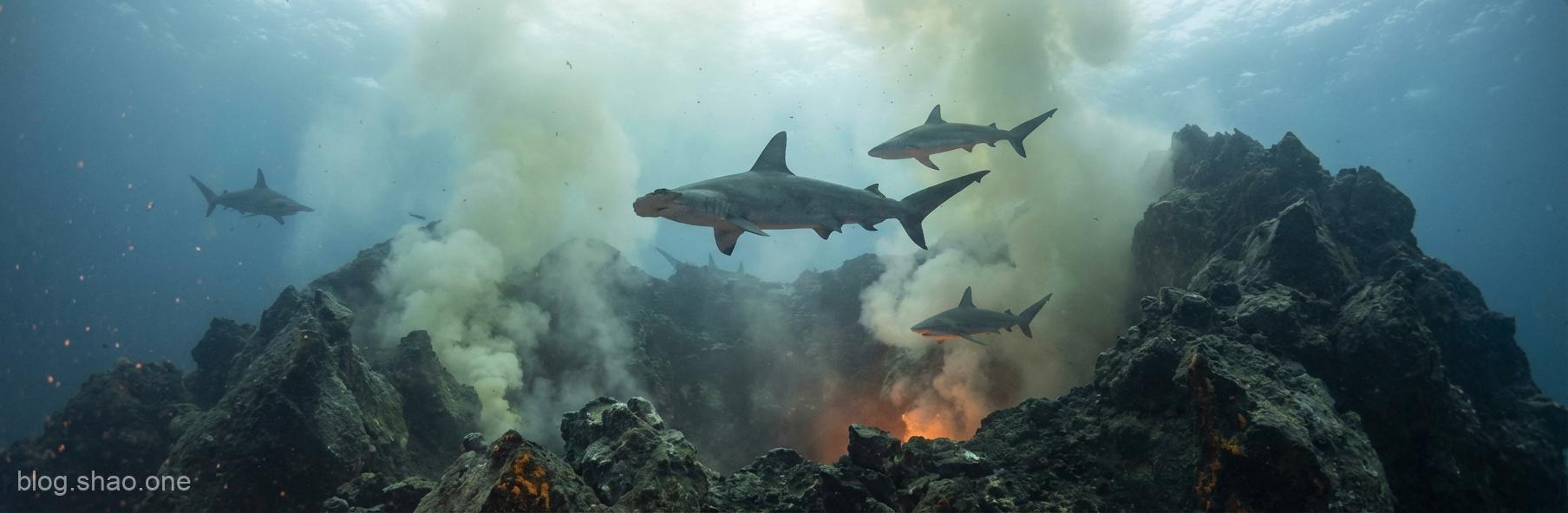
Scientists deployed a deep-sea remotely operated vehicle (ROV) into the crater's depths, expecting only desolate magma remnants. Instead, the images appearing on the screen left everyone gasping in astonishment. Here are the core findings from this expedition:
- Primary Residents: The footage clearly captures scalloped hammerhead sharks and silky sharks. These two shark species navigate the high-concentration chemical plume at the caldera with ease, as if strolling through their own backyard.
- Hostile Environment: Kawah Iki is one of the world's most active undersea volcanoes. Its eruptions release massive amounts of carbon dioxide and sulfur, causing the seawater to become extremely acidic and scalding hot. Any organism that strays into this realm would likely meet its demise.
- Survival Motivation: Scientists currently cannot determine why these sharks choose to remain here. One hypothesis suggests that minerals brought by volcanic activity nourish the bottom-feeding ecosystem, providing an abundant food source that makes these sharks willing to "take the risk."
In-Depth Commentary: Why Is This Matter "No Small Thing"?
This discovery is not merely an intriguing ecological anecdote; it touches upon core issues in biology and Earth science. From the perspective of technology and research, this news carries three profound implications:
1. Pushing the Limits of Biological Tolerance
In the past, we believed that large vertebrates had limits to their adaptability to the environment. However, these sharks survive in waters as acidic as strong vinegar and as hot as to scald humans, demonstrating that the resilience of life often surpasses human imagination. This may provide entirely new inspiration for future biotechnology applications in extreme environments, such as research into acid-resistant materials or heat-resistant proteins.
2. Nature's "Cutting-Edge Early Warning Technology"?
The most perplexing question remains: How do these sharks anticipate and escape when a volcano is about to erupt on a massive scale? Or do they possess a unique "evacuation strategy"? Scientists suspect that the sharks' acute sensory systems—such as electromagnetic sensing—might enable them to detect minute changes in magma activity.Solving this mystery could potentially lead to breakthroughs in developing underwater geological early warning systems for humans.
3. Another Mirror of Climate Change
As global warming and ocean acidification intensify, the extreme environment of Kavachi Volcano serves as a "miniature version of the future ocean." Observing how these sharks adapt to high-temperature, low-pH waters helps us predict how future marine ecosystems will transform under extreme climatic conditions. This invaluable data undoubtedly provides timely and crucial insights for developing environmental technologies and marine conservation strategies.
Conclusion: Nature is always the best teacher.
As the saying goes, "You can't get the tiger's cub without entering the tiger's den." Scientists ventured deep into the undersea volcano, risking the destruction of their equipment, and the information they brought back is truly invaluable. These sharks dancing in the crater prove that even in the darkest, most dangerous places, life still finds a way.For tech enthusiasts, this also serves as a reminder: though we've developed countless advanced AI and detection instruments, we must remain humble before Earth's unfathomable mysteries. The next time you feel life presents "volcanic eruption"-like challenges, think of these sharks gliding gracefully through sulfuric fumes—with enough adaptability, even hell can become a safe haven.【Further Reflection】 Do you believe sharks are truly fearless of death, or have they mastered undersea survival techniques unknown to humans? Share your thoughts on our social media!”